Delta
0.5–4 Hz
For: sleep descent, physical recovery, full-body settling.
Induces: deep rest, heaviness, fading out — unconscious repair.
Optional — help us understand what works. —
Analog Binaural Entrainment Console · BBM MK-I
ENGAGE for console defaults · or select a patch · HALT to stop
Copy Console snapshots per phase · smooth crossfades · 6 phases max · 90 min · INFINANT holds the last phase indefinitely · ◈ HEADPHONES REQUIRED ◈
Twelve guided journeys on sub-octave Solfeggio carriers (87–200 Hz, nothing above 200) — 30–60 min with smooth phase crossfades. ◈ BINAURAL — HEADPHONES REQUIRED ◈
TIMED — timed version (set length). Default: INFINANT hold state.
Operator reference · Binaural Beat Machine MK-I
Set Beat to target a band — the Console highlights whichever range is active. Typical descent: β → α → θ → δ. Alpha bookends sessions; gamma is brief only.
For: sleep descent, physical recovery, full-body settling.
Induces: deep rest, heaviness, fading out — unconscious repair.
For: meditation, visualization, astral gateway work.
Induces: hypnagogic imagery, floating, dream-like inner vision.
For: session entry, gentle return, calm without sedation.
Induces: relaxed wakefulness, eased tension, receptive focus.
For: study, analysis, problem-solving, energized focus.
Induces: alert cognition, sustained attention — high end may feel wired.
For: brief clarity bursts, peak coherence, unified awareness.
Induces: heightened presence and insight — use short at moderate volume.
Set TIMED or INFINANT on the PROGRAMS or BUILD tab — before or during a running session. Tap the TIMED or INFINANT tab anytime to switch; the status dock updates immediately.
A full history and deep explanation of what binaural beats are, how the brain processes them, what the research shows, and how to use them safely with stereo headphones.
◈ Headphones required. Binaural beats only work when each ear receives a different carrier tone in isolation. Speakers, mono playback, or one-ear listening will not produce the effect.
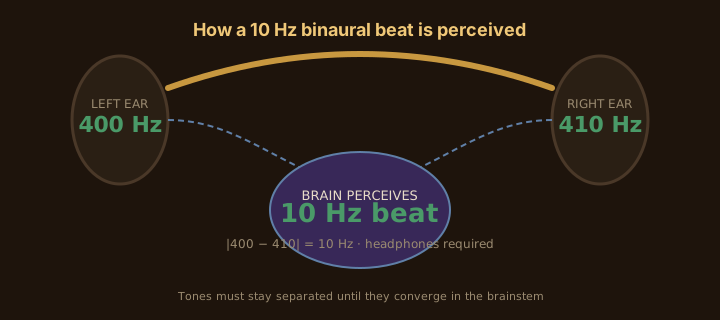
Figure 1 — The perceived beat equals the frequency difference between ears.
Binaural beats (also called binaural tones) are a real auditory illusion — an apparent “third” pulsing or beating sound that your brain creates when it receives two slightly different pure tones, one in each ear, through stereo headphones.
For example: play a steady 400 Hz tone in your left ear and a 410 Hz tone in your right ear. You will not hear two separate tones. Instead you perceive a single pulsating tone at roughly 10 Hz (the difference) that seems to come from inside your head and may even feel like it moves between your ears.
This only works with headphones (or perfect dichotic separation). Speakers or one-ear listening kills the effect because the tones must stay completely separated until they reach your brain.
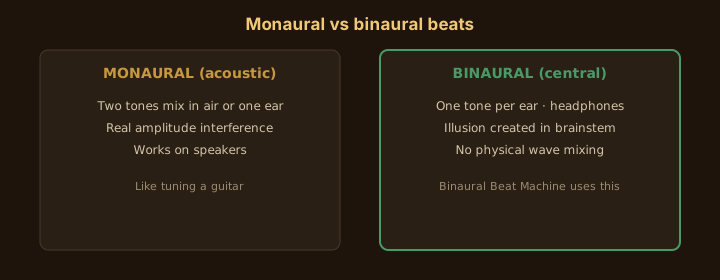
Figure 2 — Monaural beats are physical; binaural beats are central (brain-generated).
This is not the same as monaural (acoustic) beats, where two tones physically mix in the air or in one ear and create actual amplitude interference — like when tuning a guitar. Binaural beats are a purely central nervous system phenomenon. No physical sound wave mixes in the air or in the cochlea.
Binaural beats are processed in the superior olivary complex (SOC) in the brainstem — the first place where signals from both ears converge. This region is specialized for sound localization: detecting tiny interaural time and phase differences to tell where a sound is coming from in three-dimensional space.
Neurons here phase-lock and fire action potentials synchronized to the frequency difference, creating the illusory beat percept. The signal then travels to the inferior colliculus, reticular activating system (which modulates arousal), thalamus, and auditory cortex, where it can produce measurable auditory steady-state responses (ASSR) or frequency-following responses (FFR) in EEG and MEG recordings.
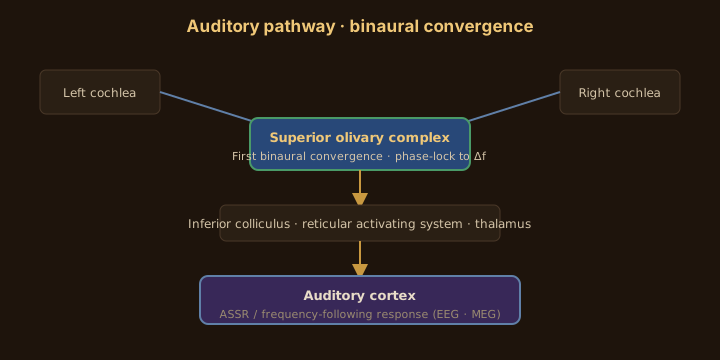
Figure 3 — Binaural convergence begins in the superior olivary complex.
Mathematically, if the left ear receives frequency fL and the right ear receives fR (with |fL − fR| < 30 Hz and carriers typically 200–1000 Hz, optimal around 400 Hz), the perceived beat frequency is:
fbeat = | fL − fR |
The brain treats this difference as a real low-frequency rhythm.
The brainwave entrainment hypothesis (BEH), also called frequency-following response, proposes that sustained exposure to a binaural beat in the EEG range (1–40 Hz) can drive or synchronize your brain’s own oscillatory activity toward that frequency. This is the basis for most wellness claims.
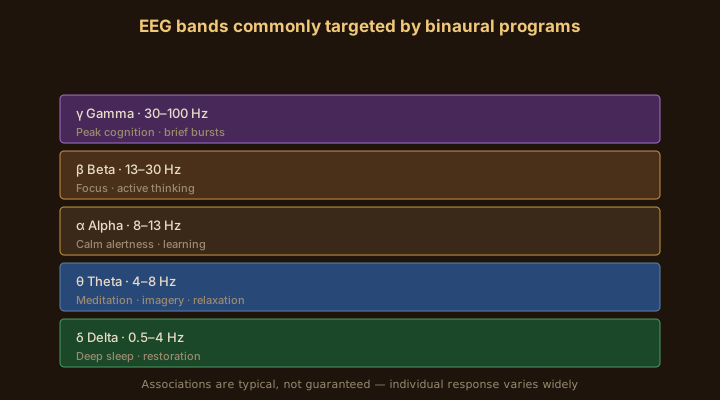
Figure 4 — Common brainwave band associations (individual results vary).
| Band | Range | Common associations |
|---|---|---|
| Delta | 0.5–4 Hz | Deep sleep, healing, unconscious processing |
| Theta | 4–8 Hz | Deep relaxation, meditation, creativity, hypnosis, reduced anxiety |
| Alpha | 8–13 Hz | Calm alertness, relaxed focus, learning, light meditation |
| Beta | 13–30 Hz | Active thinking, concentration, alertness (higher ends can feel anxious) |
| Gamma | >30–100 Hz | High-level cognition, insight, binding of perception, peak focus |
Often, tracks embed the beats in pleasant music, pink or white noise, or isochronic tones (regular pulses in one ear) for better tolerability. Perception varies: some people are highly sensitive, others perceive weak or no effect (for example, linked to neurological conditions like untreated Parkinson’s in early studies). Women showed cycle-related differences per Oster.
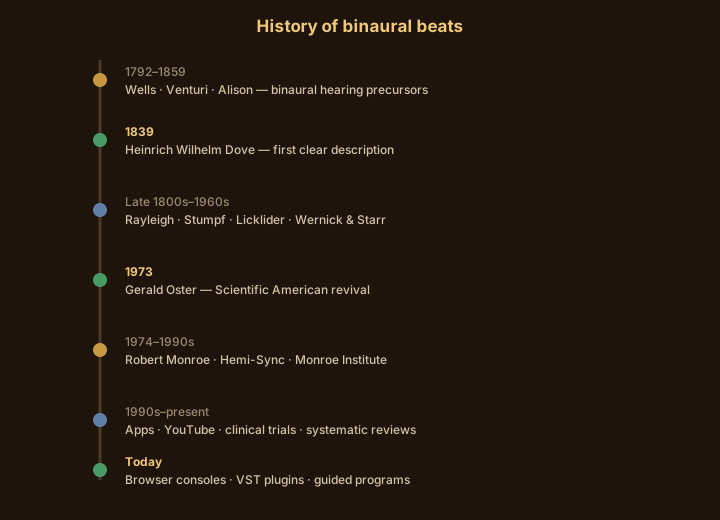
Figure 5 — From binaural hearing science to modern entrainment tools.
The perceptual phenomenon is well established and measurable. Effects on brain states and behavior are more nuanced.
A 2023 systematic review of 14 EEG studies on entrainment found 5 supportive (power increases in targeted bands like theta, alpha, and gamma), 8 contradictory, and 1 mixed — due to massive methodological heterogeneity (different frequencies, durations, analyses, and controls).
Other meta-analyses and reviews show moderate positive effects (effect size roughly g = 0.45) as adjuncts for anxiety reduction, pain relief (especially theta), attention and memory, relaxation, and sometimes cognition and sleep — stronger with longer sessions (10–30+ minutes), task timing, and quality audio. Some evidence exists for reduced anesthetic needs or easier meditation entry.
However, results vary widely. Placebo, expectation, and individual differences play major roles. This is not a miracle cure or strong hallucinogen — marketing often overstates the effects.
It is safe for most people (no major side effects reported; rare headaches or dizziness). It is not a substitute for medical treatment. Consult a doctor for serious conditions. Use caution with epilepsy when combining with flashing visual elements, though pure audio alone is generally low-risk.
Binaural beats are a fascinating, accessible window into psychoacoustics, neuroscience, and consciousness exploration — rooted in solid science since Dove and Oster, popularized by Monroe, and still evolving today. The core illusion is undeniable; the deeper benefits are promising but context-dependent and not universally transformative. They are a low-cost, zero-risk tool worth experimenting with mindfully.
For deeper reading beyond this guide: Oster’s 1973 Scientific American article (archived online), the Wikipedia entry on binaural beats, and the 2023 PLOS systematic review on EEG entrainment. Enjoy exploring your brain’s remarkable processing power.
Post session notes in the EXPERIENCES tab — name, rating, and text only. No email required.
The website console is fully free — no account, no paywall. These downloads help pay for hosting and development.
Questions, information, or recommendations? binauralbeatmachine@gmail.com
This website is free. Use the Console, Programs, Field Manual, and Experiences at no cost. The products below are optional — they fund the site and let you run BBM offline or inside your DAW.
Payment and download delivery are handled by Gumroad after purchase.
Console, Programs, Build A Program & Field Manual — Mac or Windows, offline.
$7
VST3 instrument for your DAW — binaural engine, ambient, tribal drum.
$15
Share your session and scroll down to read the live community feed — each report includes a star rating.
Questions, information, or recommendations? binauralbeatmachine@gmail.com
Submissions publish immediately to the feed below. Only your name, rating, and experience text appear publicly.
Scroll down — newest experiences appear first. Each card shows its star rating.
No community experiences yet. Be the first to share above.