Declassified How they were taught
Remote viewing training methods in FOIA
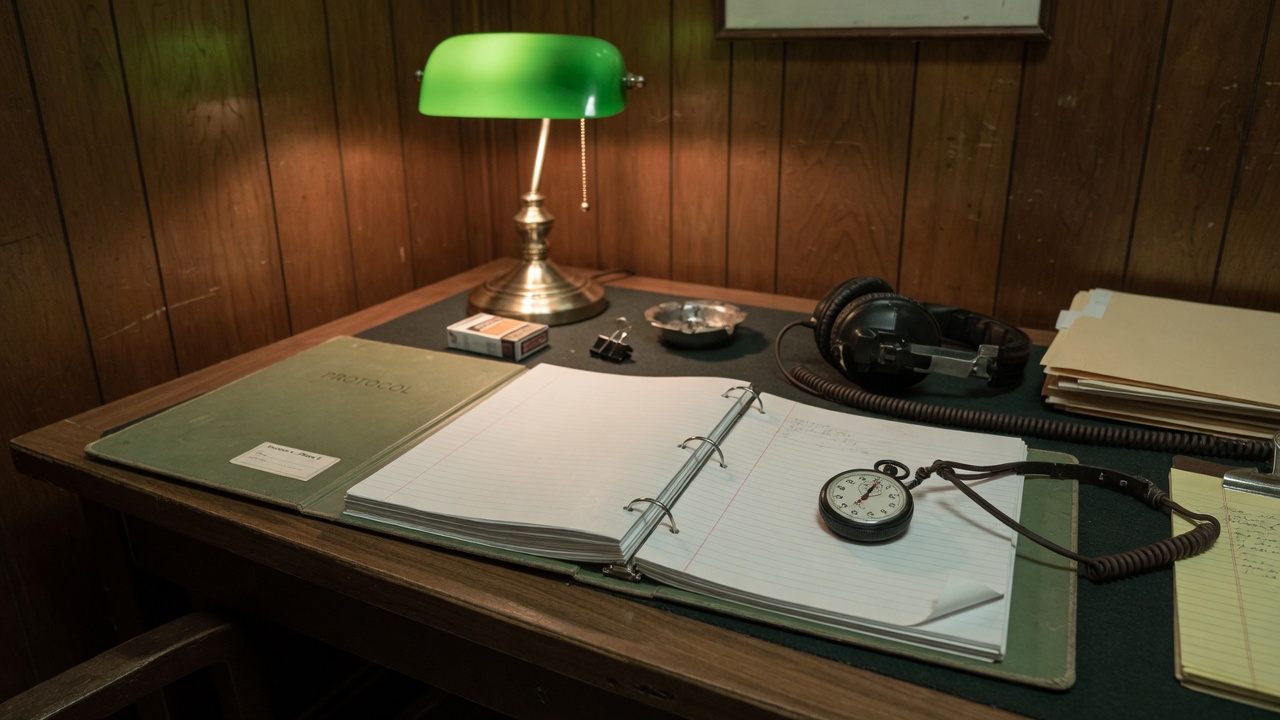
The declassified record names methods, places, and people: coordinate remote viewing from Ingo Swann at SRI; a six-stage drill transferred to Army INSCOM at Fort Meade; extended and written variants inside the unit. This page maps that trail. It is not a course.
If you want to know how U.S. remote viewers were actually taught, the FOIA trail is more specific than internet CRV ads. The methods have names, authors, and buildings. They do not require binaural beats. Optional audio on this console is a switch, not a stage in anyone’s protocol.
Where the method was built
Stanford Research Institute (later SRI International) in Menlo Park ran remote-viewing experiments from 1972 under physicists Russell Targ and Harold Puthoff, with intelligence and Army interest documented in the STAR GATE series. One targeting method they investigated was coordinate remote viewing (CRV): the viewer is given geographic coordinates (degrees, minutes, seconds) and no other site information, then asked to describe the place.
SRI consultant Ingo Swann developed a six-stage training procedure around that coordinate handle. Grill Flame-era SRI reports (including CIA-RDP96-00788R001300280001-8 and related enhancement task papers) describe it as an attempt to cut “noise” — imagination, room cues, and a chatty interviewer — out of the product. The documented controls are blunt: repeat the coordinate and demand a fast first mark; sit in a featureless, homogeneously colored, acoustic-tiled chamber; keep the monitor’s speech tightly limited.
The six stages as written
The same reports outline six stages of proficiency, hypothesized as deeper contact with the site. In a session, an experienced viewer was expected to recapitulate them in order:
Stage I — major gestalt. Immediate kinesthetic “ideogram” (a quick squiggle) meant to catch land, water, mountain, city. Stage II — sensory contact (cold, dry, wind). Stage III — dimension, motion, mobility (scale, panorama). Stage IV — qualitative / quantitative aspects (technological, cultural, two buildings). Stage V — specific analytical aspects by “interrogating the signal line” (function language). Stage VI — three-dimensional contact (modeling, layout).
That list is the government’s own table, not a later brand. A 1986 “Controlled Remote Viewing” manual that circulated after the fact was prepared as a training explanation of Swann’s SRI method; it is a historical document, not a license, and later commercial CRV/TRV shops are not this FOIA file.
Who was taught, and where
SRI’s enhancement task in the early 1980s was to make the procedure transmissible. Reports describe orientation of experienced and novice viewers, hundreds of Swann’s own training trials on worldwide practice sites, and transfer to the Army unit. In 1983–1984, personnel from the military remote-viewing shop at Fort Meade (INSCOM’s Grill Flame era) took contracted SRI training. Joseph W. McMoneagle is the best-documented operational viewer in the public trail; he is often distinguished from Swann-stage CRV in later commentary — the files themselves treat “viewer,” “monitor,” and “method” as job roles, not a single personality cult.
Inside the unit, other labels appear beside CRV. Extended remote viewing (ERV) is a longer, less rigidly staged sit, often near sleep or deep relaxation, used as an alternate to the six-stage drill. Written remote viewing (WRV) and related paper methods show up in training and proficiency notes as ways to get words and sketches onto a page under a monitor. Do not flatten these into one commercial trademark. Read the session header: method, monitor, date, tasking type (training site vs operational problem).
What a session looked like on paper
Typical Grill Flame / STAR GATE training paperwork is a small loop: a handle (coordinate, sealed envelope, or other designator), a monitor who is supposed not to leak the site, a viewer who marks and speaks, then feedback when the protocol allows it. Operational tasking used the same shop furniture against real collection problems — which is why close-out review later asked about utility, not only about training curves.
You will not find, as doctrine, a requirement that the viewer wear headphones or lock a binaural beat. Consciousness research put RV and hemispheric audio in adjacent file cabinets. That adjacency is why this machine has a scored RV lab next to a stereo console. It is not why CRV has a frequency.
Editorial reading of declassified material. The official PDF is authoritative. Not medical, legal, or intelligence advice. Not a claim that consumer audio recreates historical units. The live lab is observational, not proof.