Console · About · Articles · Do binaural beats work?
Evidence
Do binaural beats work?
They work as an auditory illusion. Whether they change memory, sleep, or anxiety is a different, more modest, mixed literature.
The honest answer
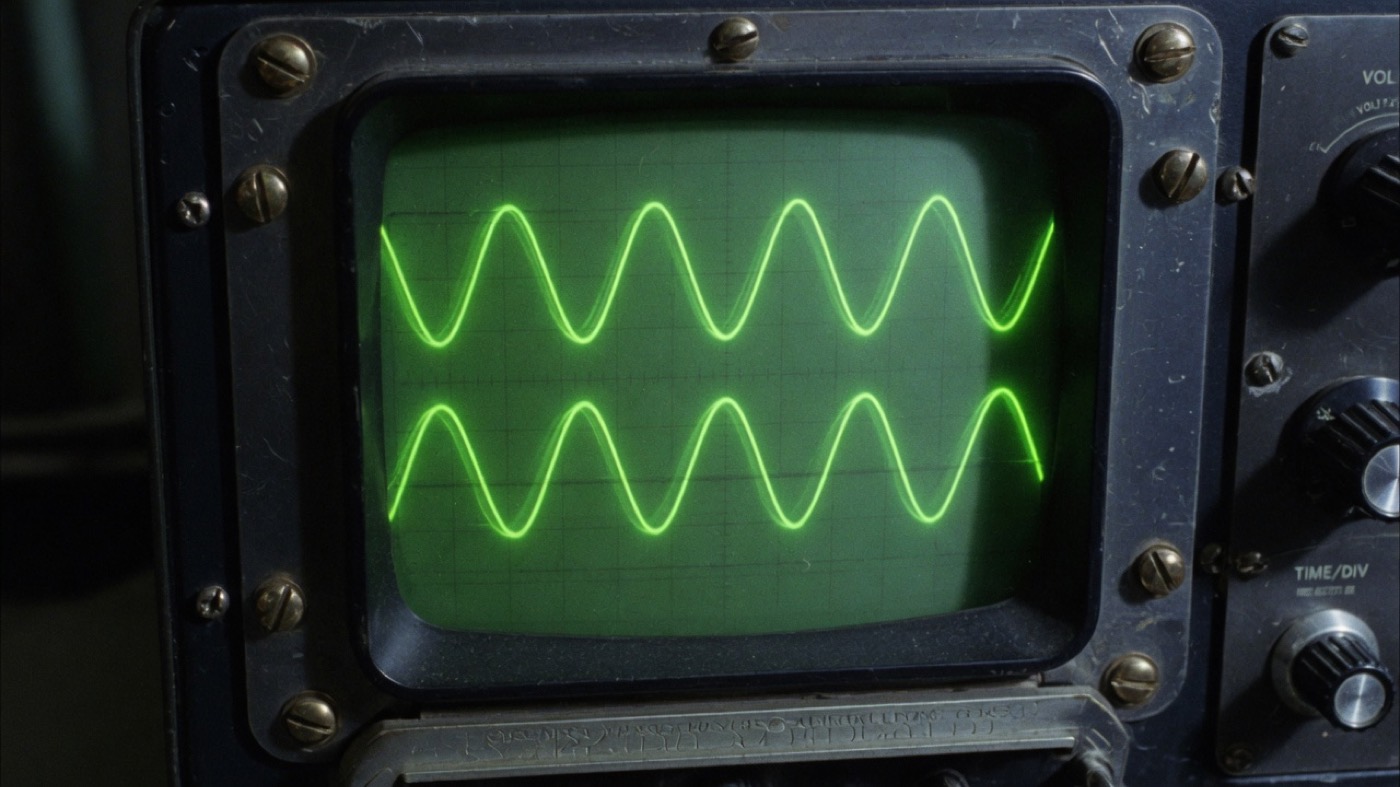
Split the question. If you mean “do I hear a beat when each ear gets a slightly different tone through headphones?” — yes, for most listeners, if the stereo path is honest. That is established psychoacoustics. Dove in 1839, Oster in 1973, a brainstem that already compares ears.
If you mean “does my EEG lock to the difference like a tuner needle?” — sometimes, in some designs, for some measures. Frequency-following and ASSR-style papers exist. Null and limited cortical papers exist too. Lopez-Caballero and Escera (2017) belongs on that second pile. Do not flatten them into a yes.
If you mean “will sleep, focus, or anxiety move because I pressed ENGAGE?” — the honest literature is mixed and modest. Garcia-Argibay, Santed and Reales (2019) pooled 22 studies and 35 effect sizes and reported an overall Hedges’ g around 0.45, with heterogeneity you are not allowed to hide. That is not a wellness certificate. It is not a device clearance. It is a meta-analysis of small experimental literatures. Placebo, expectation, and sloppy audio controls all sit in the room.
Three questions, not one
Search boxes glue three claims together with a single verb. Work is a blunt tool. A compressor works. A rumor works. A ritual works. I will not let this console hide inside that blur. I am Jonathan Allee, an engineer, not a trialist. The job on this page is to unscrew the verb until the three questions can sit on the bench without touching.
- Do you hear a beat?
- Does EEG follow the difference?
- Do sleep, focus, or anxiety outcomes move?
Answer one does not purchase answer three. That is the whole ethics of the desk. People who sell answer three with the certainty of answer one are selling a staircase that skips a floor. The mechanism essay is how binaural beats work. The definition lives next door. This page is the evidence floor.
A percept can be real and an outcome can still be small. Both sentences can be true in the same hour.
Do you hear a beat?
Yes — if the file is true stereo, if the cups isolate, if the difference is in a range your auditory system will render as a pulse. Left 200 Hz, right 210 Hz, perceived 10 Hz. Most listeners with two working ears can find it once someone tells them what to listen for. Some hear it immediately. Some need a minute. A few barely get it. Asymmetry of hearing, attention, and the carrier choice all lean on the result.
Headphones are not a brand preference here. They are the condition. Speakers fold the two carriers into one air and the binaural object collapses. That failure is acoustic, not spiritual. If a demo “doesn’t work” on a soundbar, you have learned something about the soundbar.
This first question is established. The superior olivary complex compares the ears. Oster’s 1973 Scientific American piece, “Auditory beats in the brain,” remains the essay I hand to people who want the illusion without the catalog. Dove’s 1839 observation is the old brass plate on the door. You do not need a new guru to inherit either.
Oster, G. (1973). Auditory beats in the brain. Scientific American, 229(4), 94–102. Dove, H. W. (1839), early observation of binaural beating.
Does EEG follow?
Sometimes. That is the longest honest word I have for the cortical story. There is a literature on frequency-following responses and auditory steady-state responses. Some designs report activity related to the difference frequency. Some do not, or they report it in a narrower way than the thumbnail implied. Electrode choice, carrier, duration, attention task, and analysis window all move the needle. A YouTube title that says “this track puts you in theta” is not an EEG paper. It is a wish with a compressor.
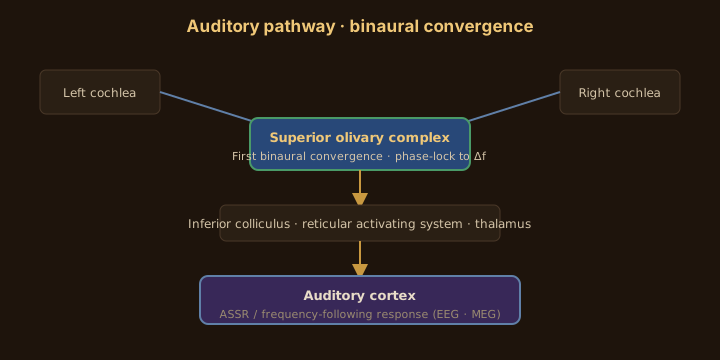
Lopez-Caballero and Escera (2017) is one of the papers I keep visible because it refuses to flatter the catalog. In their hands, several of the stronger cortical and arousal claims did not land. A single null does not delete a field. A single positive does not crown one. If your favorite thread only quotes the positives, you are reading a brochure. If it only quotes the nulls, you are reading a different brochure. I want both on the same stand.
Supported, then: some FFR/ASSR literature. Not supported: a guaranteed match between the oscillator you chose and the trace a tech would print. The second claim is the one that sells courses. It is also the one that dies in a methods section.
Do daily outcomes move?
This is where people actually live: sleep, a work block, a tight chest before a meeting. It is also where the literature is mixed, small, and noisy. Trials differ in carrier, difference, duration, control track, and what they bother to measure. Some use white noise. Some use silence. Some use a “placebo” beat that is not a beat. Blinding audio is hard because people can hear the pulse. Expectation walks into the booth with the participant.
I will not tell you the outcomes never move. I will not tell you they move like a pill. A listening ritual can change a night because dim light, a timer, and a pair of cups changed the night. That is not nothing. It is also not a specific effect of 2.5 Hz. The sleep inquiry and the focus inquiry take those rooms in more detail. Stay here for the pooled picture.
Not a device, not a clinic. A meta-analysis is not a clearance. If sleep or mood is a clinical problem, that conversation belongs with a clinician. This console is an instrument.
What Garcia-Argibay 2019 pooled
The paper I put in the colophon of this desk is Garcia-Argibay, Santed and Reales (2019), in Psychological Research. They pooled experimental work on binaural auditory beats across cognition, anxiety, and pain-perception domains. Twenty-two studies. Thirty-five effect sizes. Overall Hedges’ g around 0.45. That number has been used as a trumpet. It should be used as a ruler with a warning label.
A g of 0.45 is a moderate average in the language of effect sizes. It is not a law of your Tuesday. Heterogeneity was real: the studies do not sing one note. Frequency band mattered. Exposure time mattered. The authors are explicit enough that anyone who quotes only the headline is working for a landing page. I quote the headline and the heterogeneity because hiding either one is a kind of lie.
Garcia-Argibay, M., Santed, M. A., & Reales, J. M. (2019). Efficacy of binaural auditory beats in cognition, anxiety, and pain perception: a meta-analysis. Psychological Research, 83(2), 357–372. DOI 10.1007/s00426-018-1066-8. PMID 30073406. Not FDA clearance.
The same group’s memory paper is the detail I hand to people who want a “genius frequency.” In that paradigm, beta-range beats helped recall relative to control and theta-range beats hurt it. Opposite directions. If you still believe “any binaural beat helps the mind,” you have not read the paper. The public walkthrough of the meta-analysis on this site is Garcia-Argibay 2019. Read it as a map of a small, uneven field. Do not read it as a hymn.
I also will not launder that g into a consumer promise. Sample sizes in this literature are often small. Audio controls are often sloppy — a mono file labeled binaural, a carrier that was never reported, a session shorter than a pop song. Publication bias is not a conspiracy theory; it is a weather pattern in psychology. A pooled 0.45 under those clouds is a signal to keep studying, not a signal to print a guarantee on a WAV.
Null designs and anxiety trials
Padmanabhan, Hildreth and Laws (2005) is the preoperative-anxiety study that wellness copy likes because it has a hospital hallway in the background. Day-case surgery. A binaural-beat audio condition. Self-reported anxiety around an operation. It is a real paper. It is also a specific context: a waiting area, a particular recording, a particular scale, a moment when almost any structured calm might move a number. I will not drag a day-surgery waiting room onto your sofa and call it a treatment plan. I will not ignore the paper either. It sits in the mixed pile, with the sample and the setting stapled to it.
Padmanabhan, R., Hildreth, A. J., & Laws, D. (2005). A prospective, randomised, controlled study examining binaural beat audio and pre-operative anxiety in day-case surgery. Anaesthesia, 60(9), 874–877. Context is not a protocol you should steal.
Lopez-Caballero and Escera belong here again, on the cortical side. Limited claims. Nulls where a catalog wanted fireworks. If you are building a worldview out of binaural beats, you need a shelf that can hold a quiet paper. The methodology of this console — what we generate, what we do not claim — is public at methodology. We generate two carriers and a difference. We do not generate a certified brain state.
What would falsify a claim
A claim that cannot die is not a claim. It is a slogan. Here is how I would watch one die.
- “You will hear a beat.” Falsified for a given file if a pan test shows identical left and right, or if playback is mono. Falsified as a universal human fact if a large share of listeners with verified stereo isolation report no pulse across a sensible difference range — which is not the current picture, but it would be the picture to watch.
- “EEG will match the difference.” Falsified as a guarantee by the existing mixed FFR/ASSR record. Already false as a guarantee. Still open as a sometimes, in some designs.
- “This frequency treats insomnia / anxiety / attention.” Falsified as a treatment claim by the absence of that kind of evidence and by the ethics of the word treat. Outcome movement in small trials does not license the verb.
- “g = 0.45 means it works for wellness.” Falsified by the authors’ own heterogeneity, by domain splits, by the beta-versus-theta sign flip, and by the difference between a pooled experimental literature and a person’s night.
If I catch this site sliding from “illusion” to “guarantee,” the site is wrong. The Console will still make two sines. The copy will have failed. I would rather lose a ranking than keep a sentence that cannot be killed.
Four levels of claim
The auditory illusion. Two isolated carriers. Brainstem comparison, superior olivary complex. Headphones required. Speakers collapse the difference.
Some EEG FFR/ASSR literature reports following of the difference in some designs. A real shelf. Not a tuner needle on every forehead.
Outcome studies. Garcia-Argibay 2019: 22 studies, 35 effect sizes, g ≈ 0.45, heterogeneity. Padmanabhan 2005 in a surgical waiting context. Small trials. Placebo and expectation in the booth.
Cure, downloaded knowledge, guaranteed EEG match, “clinically proven website,” any copy that treats g ≈ 0.45 as a wellness proof.
Do they work? As a beat you can hear — yes, with cups and a true pair. As a cortical follower — sometimes, mixed. As a life outcome — modest, uneven, easy to overclaim. Keep the three answers in three drawers. The desk at the Console will still be there after you close the paper.
What we still do not know
We do not yet have a large, pre-registered, well-controlled literature that holds carrier, difference, duration, and a truly inert audio control still while measuring sleep staging or workplace attention in the wild. Until that shelf exists, every consumer promise is running ahead of the trucks.
We also do not know how much of the modest outcome signal is the difference frequency, how much is any structured sound, and how much is the ritual of putting cups on and doing one thing for twenty minutes. Those are separable questions. Most studies do not separate them. I will not pretend I did.
Questions operators actually ask
So do binaural beats work or not?
They work as an auditory illusion if the stereo path is honest and you are wearing headphones. Whether EEG follows is mixed. Whether sleep or focus changes is a modest, heterogeneous outcome literature. Do not let one verb cover all three.
What does Hedges’ g of about 0.45 mean here?
In Garcia-Argibay, Santed and Reales (2019) it is the overall pooled effect across 22 studies and 35 effect sizes. It is a moderate average with real heterogeneity. It is not a device clearance and not a proof that your Tuesday will move.
Did a study prove binaural beats reduce anxiety?
Some trials, including Padmanabhan, Hildreth and Laws (2005) in a preoperative setting, reported shifts on anxiety measures. That is a specific context, not a treatment license. If anxiety is a clinical problem, see a clinician.
Why do some EEG papers show nothing?
Because cortical following is not a switch. Design, electrodes, attention, and analysis all matter. Lopez-Caballero and Escera (2017) is one limited/null report. A mixed shelf is what an honest desk keeps.
Can speakers still “work” if I just want to relax?
Speakers can play a pleasant bed. They cannot deliver a binaural beat, because the two carriers meet in the air. If relaxation is the only goal, say that. Do not keep the binaural label after the mechanism is gone.
What would make you retract a strong claim?
A pan test that shows identical channels retracts a binaural file claim immediately. A guaranteed EEG match is already retracted by the mixed FFR record. A treatment claim was never licensed by this literature.
Is the 2019 meta-analysis out of date?
It is the synthesis this desk still uses as the public map, with its limits stapled to it. Later small trials exist. They have not, as a body, turned a mixed field into a settled one. I will update the map when a better map exists.
Keep reading
Educational listening notes from a working audio engineer. Not medical advice. Not a medical device. Headphones required for a true binaural beat. Methodology · About · Garcia-Argibay 2019