Console · About · Articles · Binaural beats for focus
Focus
Binaural beats for focus
Beta and low-gamma designs are used as attention beds. The honest move is a timed session, a clear task, and no miracle claim.
The honest answer
A focus session on this desk is a work bed, not a genius frequency. I point a beta-range or SMR-ish difference at a block of real work, set a timer, and keep the carriers quiet enough that they can sit under a sentence. The task is the point. The pair is furniture.
The literature is mixed and band-dependent. Garcia-Argibay’s 2019 memory paper is the one I keep on the blotter: in that paradigm, beta-range beats helped recall relative to control and theta-range beats hurt it. Opposite directions. “Any binaural beat helps you think” is already false on that page. The broader 2019 meta-analysis (22 studies, 35 effect sizes, g ≈ 0.45 overall, heterogeneity) is a map of a small field, not a diploma.
Headphones. A true-stereo pair. A task you can finish. Halt. If attention is a clinical story, that story belongs with a clinician. This is a console.
A work bed, not a genius frequency
I have mixed records in rooms that cost more per day than some people spend on rent. Focus, in those rooms, is a schedule and a pair of speakers that tell the truth. It is not a secret hertz. When I put binaural carriers under my own work, I am doing something smaller than the internet promised. I am hanging a steady disagreement between the ears so the room has a pulse I did not have to compose. Then I write, or I edit, or I answer the thing I have been circling.
Call it a bed. Beds are allowed to be boring. If the pair is interesting, it is already competing. Interest is for music. A focus bed should be almost ignorable — present enough to mark the block, quiet enough that a sentence can land on top of it. The moment you start chasing the pulse, you are no longer on the task. Halt, or turn the carriers down until they recede.
If the tone is the most interesting object on the desk, the session has already failed as work.
The short door is binaural beats for focus. The library is programs. Neither door will make you clever. Both will give you a timed stereo pair if you want one. The rest of this inquiry is how I refuse the genius story while still using the instrument.
Beta, SMR-ish, and the opposite of theta
Beta-range differences — roughly 13–30 Hz as a designed beat — are the usual work pointing. Low beta can feel like a taut wire. Mid beta can feel busy. People also talk about SMR, the sensorimotor-ish neighborhood around 12–15 Hz, as a “calm alert” target. I will use SMR-ish the way I use other borrowed EEG words: as a region on the oscillator, not as a certificate of your motor cortex.
Theta is a different tool. Dusk, sit, wind-down. In at least one memory paradigm, theta-range binaural beats moved recall in the wrong direction relative to control while beta moved it in the right one. If you put a 6 Hz pair under a tax form because a video said “meditation focus,” you may have chosen the dusk tool for a noon job. Band is not personality. Band is a design choice with a direction.
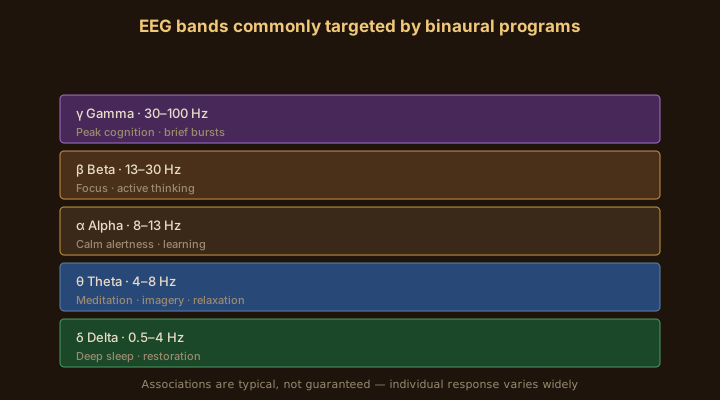
The atlas is brainwave bands. The calculator is here if you want 18 Hz as 200/218 instead of as a mood word. Forty hertz is a different inquiry — gamma culture, MIT-adjacent headlines, consumer files that are not those protocols. Do not drag 40 Hz onto a spreadsheet because the number is famous. Famous is not a task.
Timed session plus a real task
Pair the pair. I mean that literally. Choose the work first: one scene, one function, one page, one inbox you will actually close. Then choose a length that matches the work — twenty-five minutes if you like a pomodoro shape, fifty if the task is a long cut, not three hours because a program thumbnail said “deep work infinite.” Infinite is how you get tired and blame the oscillators.
ENGAGE at the start of the block. Halt at the end. Stand up. The console is not a roommate. The open desk is the Console. If you need a timeline with phases, the programs will do that. If you need a static 16 Hz difference under a coding hour, the live oscillators will do that. The honesty is the same: the work has to exist, or you have built a very precise way to sit still.
I journal the block in one line. Task, difference, minutes, whether the sentence moved. After a week you will know if the bed is helping you start, helping you continue, or just occupying the cups. n=1 is allowed as personal craft. n=1 is not a paper. Do not post your Tuesday as a protocol.
No download. A binaural pair will not encode a textbook. If studying is the job, the job is still the page. There is a later inquiry for that room. This one is the work bed.
What the memory paper found
Garcia-Argibay, Santed and Reales (2019), “Binaural auditory beats affect long-term memory,” is the sign-flip I want in every focus conversation. Beta-range beats, in their paradigm, improved long-term memory performance relative to white noise. Theta-range beats impaired it relative to that control. The sentence “binaural beats help memory” is already too coarse to survive the paper. You have to say which difference.
The companion meta-analysis the same year — 22 studies, 35 effect sizes, overall Hedges’ g around 0.45, heterogeneity you cannot sand off — pooled memory, attention, anxiety, and pain-perception trials. Attention effects were not a marching band. Anxiety findings do not make this page a calm clinic. Pain findings do not make a console an analgesic. The public walkthrough is the 2019 meta-analysis. Read the forest. Do not harvest a single tree for a thumbnail.
Garcia-Argibay, M., Santed, M. A., & Reales, J. M. (2019). Binaural auditory beats affect long-term memory. Psychological Research, 83(6), 1124–1136. And the meta-analysis: Psychological Research, 83(2), 357–372. DOI 10.1007/s00426-018-1066-8. PMID 30073406. Not a device clearance.
Lopez-Caballero and Escera (2017) still limit the cortical swagger. Padmanabhan, Hildreth and Laws (2005) is a preoperative-anxiety study, not a deep-work study; I will not steal a waiting room to furnish this desk. Oster (1973) and Dove (1839) remain the illusion’s brass plates. They do not owe you a completed draft.
Supported, then: some EEG following literature, some cognitive trials with band-specific signs. Mixed: the outcome field as a whole. Unsupported: a genius frequency, a guaranteed EEG match, a promise that 20 Hz is a degree. I will not sell you the unsupported layer because it would be easy. Easy is how this niche became a junk drawer.
A desk setup that does not lie
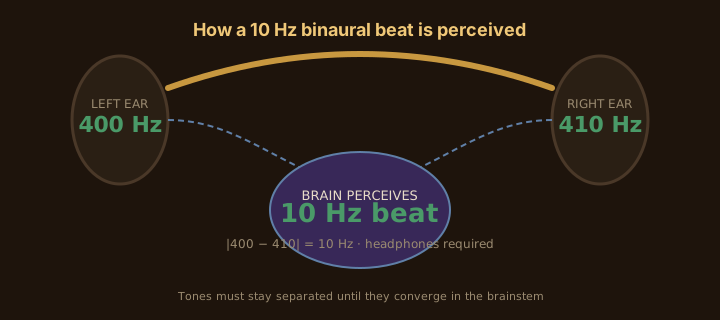
Headphones. True stereo. That is the mechanism, same as every other inquiry. Speakers at the desk will give you a room and maybe a pleasant drone. They will not give you a binaural beat. Cheap cups can carry the difference if both drivers live and the path stays stereo — cheap headphones can work. Boutique pads are comfort for a two-hour sit. Comfort matters. Physics does not require the boutique.
Volume stays under the work. If you cannot hear your own typing because the carriers are a brass section, you have mixed the bed like a lead. Carriers in the 150–400 Hz neighborhood are a common comfort window for daytime sitting. If they itch, move them. The difference is the design target. The carrier is the chair.
Notifications are a louder enemy than the wrong band. A 16 Hz pair will not outrun a lock screen. Put the phone down. The ritual is the block. Engineering notes for the pair we generate are public at methodology. Hardware notes sit in the headphones guide. Mechanism, if you want it in the middle of a workday, is how binaural beats work. Then close the tabs. The tabs were the problem.
What I actually do at the desk
A weekday block, when I use the instrument: over-ears, a beta-range difference I already know I can ignore — often something in the mid teens — carriers around 200 Hz, level barely above the hiss of the room. One task written on a pad. Forty minutes. ENGAGE. Work. Halt. Walk to the kitchen. I do not stack a second band in the same hour to “optimize.” Stacking is how you end up mixing instead of finishing.
If the day is already jagged, I do not reach for a hotter beta to whip it. I either sit in silence or I pick a quieter bed. High beta as a stimulant is a story people tell when they would rather not take a walk. The walk is still available. The console will not be offended.
If attention is a diagnosed story, or a story that is costing you a life, this paragraph is the boundary. See a clinician. A work bed can sit beside care. It is not care. I will not borrow clinical language to dress a pair of sines. The sines are enough, as sines.
One more craft note from sessions that went badly: caffeine plus a hot beta bed plus an empty task list is just jitter with a brand. Eat the lunch. Write the task. Then, if you still want the pair, ENGAGE. The order is the method. Reversing the order is how people decide the frequencies “don’t work,” when what failed was the morning.
Four levels of claim
The auditory illusion. Two isolated carriers, a perceived pulse at the difference. Superior olivary comparison. Headphones required. Speakers collapse it.
Some FFR/ASSR EEG literature. Some cognitive trials, including band-specific memory results, that are worth reading without turning them into a brand.
Attention and memory outcomes as a field. Garcia-Argibay 2019 pooled g ≈ 0.45 with heterogeneity. Beta and theta can move opposite ways. Placebo and task quality in every booth.
Genius frequency, downloaded skill, guaranteed EEG match, “20 Hz is a degree.” Also any copy that treats a work bed as care.
Point the oscillators at a beta-range disagreement if you want a bed. Point your hands at the actual work. Halt when the block is over. That is the whole operator’s method. It will not trend. It will finish a page.
What we still do not know
We do not know how much of a good work block is the difference frequency and how much is the simple fact of a timer, headphones, and one written task. Those ingredients travel together. Most studies do not unbundle them. My own n=1 cannot unbundle them either.
We also do not know where SMR-ish pointing sits, for a given person, relative to low beta. The labels are borrowed. Individual comfort dominates. I will not freeze a single hertz as the desk standard just to make a chart look like a product.
Questions operators actually ask
What frequency is best for focus?
There is no genius number. Beta-range or SMR-ish differences are the usual work-bed targets. In one memory paper, beta helped recall and theta hurt it, so band choice is not a free adjective. Pick a pair you can ignore and pair it with a real task.
Can I use theta beats to concentrate?
You can, but it is a dusk tool. At least one memory paradigm found theta-range binaural beats impaired recall relative to control while beta improved it. If the job is active work, start in a beta-range bed and judge your own block.
Do I need expensive headphones for work sessions?
No. You need two working drivers and a stereo path. Cheap cups can carry the difference. Comfort matters for a long sit. Speakers still collapse the binaural mechanism, expensive or not.
How long should a focus session be?
Match the task, not a thumbnail. Twenty-five to fifty minutes is a humane block for most desk work. Halt at the end. Infinite sessions are how you get tired and blame the oscillators.
Will this make me smarter?
No. A binaural pair will not download skill or encode a textbook. At best it is furniture under work you were already going to do. The 2019 pooled effects are modest and mixed, not a diploma.
What did Garcia-Argibay actually find?
The memory paper reported beta-range beats helping long-term memory performance and theta-range beats hurting it, relative to control. The same-year meta-analysis pooled 22 studies and 35 effect sizes with an overall g around 0.45 and real heterogeneity. Neither is a device clearance.
Should I stack several beat frequencies at once?
I do not, not for work. Stacking turns the session into a mix. One designed difference, one task, one timer. If you want a different band, wait for the next block.
What if the tones make me jittery?
Turn them down, move the carriers, or drop to a slower difference. If the day is already jagged, a hotter beta is not a whip. Silence and a walk are still legal. Stop if it feels wrong.
Keep reading
Educational listening notes from a working audio engineer. Not medical advice. Not a medical device. Headphones required for a true binaural beat. Methodology · About · Garcia-Argibay 2019