Console · About · Articles · Binaural beats for sleep
Sleep
Binaural beats for sleep
Delta-range designs are a listening target, not a sedative. Use them as a wind-down ritual with headphones — never as a treatment for insomnia.
The honest answer
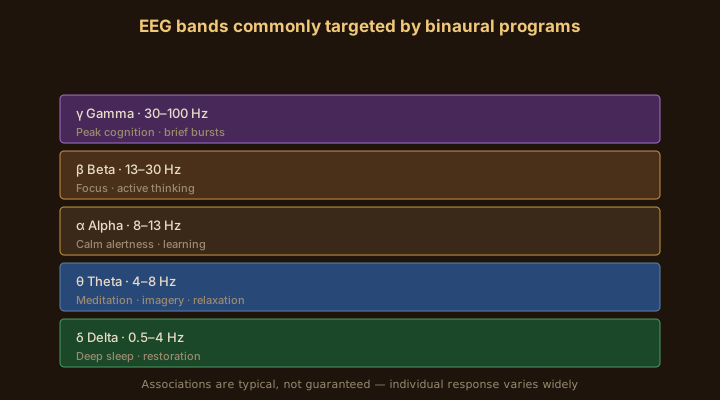
Delta, as this desk uses the word, is a listening target: a designed difference around 0.5–4 Hz. It is not a sleeping pill. It does not stage your night. It does not replace the boring architecture of sleep — dark, cool, a time you actually go to bed, a phone that stops asking you questions.
What a binaural pair can be is a wind-down ritual. Cups on. Volume low. A timer. A slow pulse you can rest your attention on while the room gets quieter. If the stereo is honest, you may hear that pulse. If the stereo is a YouTube mono fold, you will hear a bed and a claim. Those are different nights.
If sleep is a clinical problem — insomnia that has a name, a history, a cost — this page is not your instrument. See a clinician. Keep the tones, if you like them, as a ritual beside care. Do not use them as care.
Delta as a listening target
EEG delta is a real thing in sleep science. Slow waves. Deep stages. A chart a tech can score. A 2 Hz binaural difference is not that chart. It is two carriers, a few hundred hertz up, disagreeing twice a second, delivered to isolated ears. You may perceive a slow pulse. You may not. Either way, you have not been dropped into stage N3 by a filename.
I use the band words the way I use tape-speed labels. They tell me what I pointed the oscillators at. They do not tell me what a cortex did while I was pointed there. The atlas is at brainwave bands. Delta on that map is roughly 0.5–4 Hz as a designed difference. Theta sits above it and is a different dusk. People mix them because both sound like night. Night is not a frequency. Night is a room.
Carriers still matter. A 2 Hz difference riding on 80 Hz rumble is a different comfort object than the same difference riding on 200 Hz. If the tone itself is annoying, the ritual is already lost. Comfort is not a luxury setting. It is the gate. Move the carriers until the pair can sit in the room without asking for attention it does not deserve.
Ritual beats magic frequency. A 2.2 Hz file at midnight with a bright screen is still a bright screen.
Timed wind-down, not a pill
The useful shape I know is ordinary. Dim the lights. Finish the last bright tab. Put the cups on. ENGAGE a delta-range pair, or a program that walks toward one. Set a length you would have given a record: twenty minutes, forty, not “until the heat death of the playlist.” When the length ends, Halt. Take the cups off if you are going to roll onto a shoulder. Keep the room dark. That is the whole method.
The purpose page at binaural beats for sleep is the short door into that shape. The library at programs has night-oriented titles if you want a timeline instead of a static difference. I do not care which door you use. I care that you do not wait for a particular hertz to knock you over. Waiting is arousal. Arousal is the enemy of the ritual even when the ritual is gentle.
People ask for the one frequency that “does sleep.” I do not have it. I have a range, a timer, and a refusal to compete with a lamp. If a 3 Hz pair feels like wool and a 1.5 Hz pair feels like a distant pump, pick the one you can ignore. The best night tone is the one that leaves you alone.
A wind-down can include breath, a body scan, or nothing but the pulse. I am not precious about the extras. I am precious about the lie that the extras are unnecessary because the oscillator already did the work. The oscillator did the disagreement. You still have to put the day down.
Live oscillators and a recorded program are the same kind of object if the stereo is true: left carrier, right carrier, a slow difference. A program is just a timeline — carriers that walk, a bed that thickens, a halt that arrives without you watching a clock. Choose the timeline if decision-making is the arousal. Choose a static pair if you already know the night’s number. Neither format is more “scientific.” Format is furniture.
Headphones in bed
Binaural still needs isolation at 1 a.m. Speakers at the foot of the bed will give you a room tone. They will not give you a binaural beat. If you want the mechanism, the cups stay on until they do not.
Side-sleepers, this is the practical paragraph. Over-ear cups become a fulcrum. In-ear tips can lodge, irritate, or sit at a volume you would not have chosen awake. Sleeping in hardware is a comfort question and a hardware question. It is not a flex. The longer caution is falling asleep with headphones. Conservative setup: over-ear, low level, a timer, and permission to take them off when the eyelids win. The beat does not need to run until morning to “count.” Nothing is counting.
Wired is simpler at night because batteries like to die in the second hour and then chirp. Bluetooth can keep stereo. A dead case cannot. If you are going to drift, prefer a path that fails quiet.
Do not sleep on a volume you would not choose standing up. Night listening creeps. The room is quiet. The driver is close. Keep it lower than your daytime session, then lower it again.
Volume, timers, and Halt
The pulse of a delta-range pair is easy to chase with the fader. You want to “hear the 2 Hz,” so you push until the carriers are a presence. That presence will still be there at 3 a.m. if you never set a timer. Do not do that. The ear is a living object. Treat it like one.
On this console, ENGAGE starts the pair and Halt ends it. Use Halt the way you would turn off a lamp. If you built a program, give it an end minute. If you are free-running at the desk, you are the end minute. The open console is here. It will not parent you. I will not either, past this sentence.
Cheap cups are allowed. Two working drivers, stereo path, pads you can stand against a pillow. See the hardware notes in the headphones guide if you want the long version. Do not buy a sleep-specific gadget to rescue a file that was mono to begin with. Rescue the stereo. Then worry about memory foam.
What sleep studies do not show
The sleep literature around binaural beats is thinner than the thumbnails. Polysomnography — lab staging — is rarely aimed at a free consumer file. Many studies that people cite for “sleep” are actually anxiety or relaxation measures in a chair. Those can matter for a wind-down. They are not a sleep architecture paper. The public map on this site is binaural beats sleep research. Read it as a caution, not as a menu.
Garcia-Argibay, Santed and Reales (2019) pooled cognition, anxiety, and pain-perception trials — 22 studies, 35 effect sizes, overall Hedges’ g around 0.45, with heterogeneity. That meta-analysis is the honest headline for outcome work in this niche. It is not a sleep-staging clearance. It is not a license to say a 2 Hz WAV puts a stranger into slow-wave sleep. I keep the number visible so nobody can say I hid it. I keep the domain visible so nobody can say I stretched it.
Garcia-Argibay, M., Santed, M. A., & Reales, J. M. (2019). Efficacy of binaural auditory beats in cognition, anxiety, and pain perception: a meta-analysis. Psychological Research, 83(2), 357–372. DOI 10.1007/s00426-018-1066-8. PMID 30073406. Anxiety and cognition are not polysomnography.
Oster (1973) still explains the illusion. Dove (1839) still marks the old observation. Neither man owed you a night of sleep. Lopez-Caballero and Escera (2017) still sit on the cortical shelf as a limit. If a sleep-app screenshot quotes only the papers that sparkle, you are looking at a store.
Placebo is not an insult. A ritual with cups and a low tone can change a night because you marked the night. Expectation is part of every listening study that cannot be blinded like a pill. I would rather you keep a ritual that works as a ritual than chase a specific hertz that cannot carry the blame when the night is loud.
When sleep is a clinical problem
This desk does not treat insomnia. It does not diagnose it. It does not share a waiting room with a sleep lab. If your nights are a medical story — snoring that scares someone, a clock that has been broken for months, a mood that is going with them — you need a clinician. Audio can sit beside that. Audio cannot stand in for it.
I will also not borrow Padmanabhan, Hildreth and Laws (2005) as a bedtime protocol. That paper is preoperative anxiety in a day-surgery context. A waiting-room finding is not a mattress finding. Dragging it across the hallway is how this niche gets loud and then gets ignored.
Padmanabhan, R., Hildreth, A. J., & Laws, D. (2005). Preoperative anxiety and binaural-beat audio in day-case surgery. Anaesthesia, 60(9), 874–877. Different room, different question.
If you want a first listen tonight, keep it small. Headphones. A delta-range target you can ignore. A timer. Halt. The engineering of the pair is on methodology. The mechanism, if you still want the physics at 11 p.m., is how binaural beats work. Then close the article. The article is not a lullaby. It is a boundary.
Four levels of claim
The auditory illusion. Two isolated carriers, a perceived slow pulse at a delta-range difference. Superior olivary comparison. Headphones required. Speakers collapse it.
Some EEG FFR/ASSR work reports following of a difference in some designs. That is not sleep staging. It is not a night guaranteed.
Outcome studies, mostly not lab sleep. Modest pooled effects in adjacent domains. Heterogeneity. Ritual and expectation in every booth.
Sleeping-pill claims, guaranteed slow-wave induction, cure language, “this 2 Hz file is insomnia care.” Walk away. See a clinician if the nights are a condition.
Leave the oscillators pointed at a slow difference if that helps you mark the end of the day. Leave the magic at the door. The night will not be impressed by a decimal.
What we still do not know
We do not have a thick polysomnography literature on consumer binaural files with honest stereo controls. Until someone runs that work at a decent scale, every “deep sleep frequency” chart is a design chart wearing a lab coat.
We also do not know how much of a good night after a session is the difference frequency, how much is any low, boring audio, and how much is the simple fact that you stopped scrolling. I will not pick a winner among those three in the absence of a design that can tell them apart.
Questions operators actually ask
What frequency should I use to fall asleep?
There is no magic number. Delta-range differences around 0.5 to 4 Hz are a common listening target for a wind-down. Pick a pair you can ignore, set a timer, and keep the volume low. The ritual is doing more work than the decimal.
Can I play sleep beats on a bedside speaker?
You can play a pleasant bed that way. You cannot play a binaural beat that way. Speakers mix the carriers in the air and the difference collapses. Headphones are required for the mechanism.
Is it safe to fall asleep with headphones on?
Treat it as a comfort and hardware problem. Over-ear, low volume, and a timer are the conservative setup. Side-sleepers should be careful with cups and tips. Take them off when the eyelids win. Nothing is counting overnight.
Will this treat my insomnia?
No. This is a listening ritual, not care. If sleep is a clinical problem, see a clinician. You can still use a quiet pair as a wind-down beside that care. Do not substitute the console for it.
Do I need to hear the beat all night?
No. A timed session that ends is enough of a ritual. Running carriers until morning is how volume creeps and batteries die. Halt when you would have turned off a lamp.
Why do some sleep tracks feel agitating?
Carriers can be harsh, differences can sit in an itchy place, and a file labeled sleep can actually be a mixed, identical-L/R bed with a bright top. Move the carriers, drop the level, or stop. Annoyance is data.
What does the research actually show for sleep?
Less than the thumbnails. Honest maps point to mixed, often indirect findings, not lab proof that a consumer file stages slow-wave sleep. Garcia-Argibay 2019 is a pooled outcome paper in other domains. It is not a sleep-staging clearance.
Keep reading
Educational listening notes from a working audio engineer. Not medical advice. Not a medical device. Headphones required for a true binaural beat. Methodology · About · Garcia-Argibay 2019