Console · About · Articles · What are binaural beats?
Definition
What are binaural beats?
A binaural beat is not a third tone in the room. It is a perception your auditory system creates when each ear receives a slightly different pure tone.
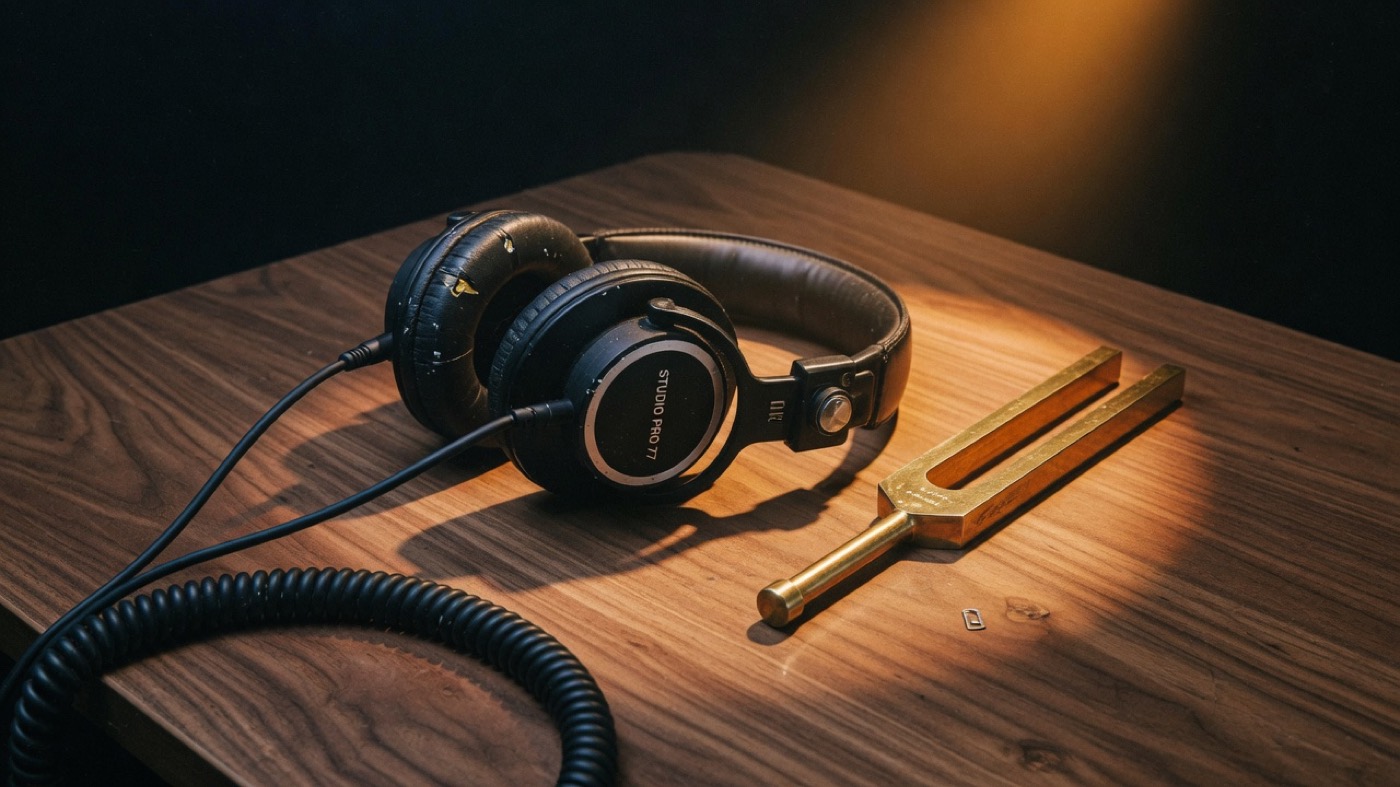
The honest answer
A binaural beat is a perception. Left ear gets one pure tone. Right ear gets another, a few hertz away. Your auditory system compares them and you may hear a slow pulse at the absolute difference: |fL − fR|. There is no third physical tone in the room. There is no extra oscillator hiding in the mix. The beat is not in the air. It is in the comparison.
Headphones are required. Speakers dump both carriers into the same air, and the difference collapses before it ever reaches the two ears as two ears. Carriers usually live around 100–900 Hz so they are audible and stable. Differences are usually kept under about 30 Hz if you want a beat you can actually follow as a beat. Band names — delta, theta, alpha, beta, gamma — are design targets borrowed from EEG charts. They are not a promise that a lab trace will match.
If you want to hear the object instead of reading it, open a true-stereo pair and change the difference while the cups stay on. That is the whole definition, made audible.
The definition, without the myth
Say the sentence slowly. Two carriers. One per ear. Perceived beat equals the absolute difference of those two frequencies. That is the entire machine. Marketing adds a third act — genius, sleep as a switch, a downloadable file of knowledge — and the sentence falls apart.
I am an audio engineer. When I say carrier, I mean a tone you can assign to a pan pot. When I say beat, I mean the rate of the pulse you perceive when the two tones disagree. I do not mean a drum. I do not mean a genre. I do not mean a medical protocol. The console on this site is built to make that disagreement on purpose, in true stereo, and to show the numbers while it does so. The interactive lesson at what are binaural beats will play the pair in the browser. The longer mechanism note is how binaural beats work.
The beat is not a third loudspeaker. If you can point to it in the room, you are pointing at something else.
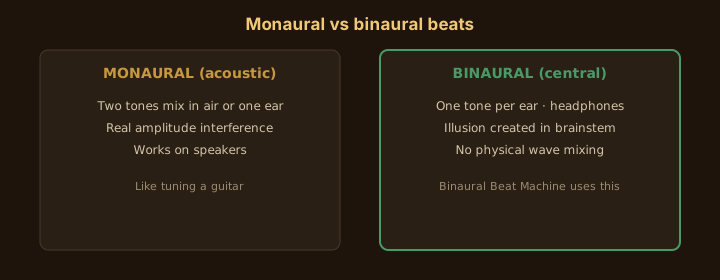
People get this wrong for a kind reason. Acoustic beating — two close tones mixed in air or in a speaker — is older than binaural language. Violinists know it. Piano tuners know it. That is a physical interference pattern. Binaural beating is a cousin with a different address. The two tones never meet in the air if the headphones are doing their job. They meet in the comparison the brainstem is already built to make.
Carriers, difference, and the missing third tone
Pick a left carrier. 200 Hz is a common studio example because it is easy to hear and easy to remember. Pick a right carrier 10 Hz higher: 210 Hz. The designed difference is 10 Hz. Many listeners perceive a soft pulsing at that rate. Raise the right carrier to 220 Hz and the pulse hurries. Bring it back toward 200 Hz and the pulse slows, then vanishes into unison.
The carriers are the audible pitches. They are the ones that occupy the drivers. Comfort lives here. If the carriers are too low, they turn into a woolly rumble. If they are too high, they turn into a thin whistle. A practical window for most of this work is roughly 100–900 Hz. That is a craft range, not a law of nature. The binaural beat calculator will do the arithmetic if you would rather not hold both numbers in your head.
The difference is usually kept under about 30 Hz when the goal is a beat you can perceive as a beat rather than as a second pitch or a roughness. You can design a 40 Hz difference. People do. The perception changes character as the difference climbs. Do not pretend every difference is the same object with a different sticker.
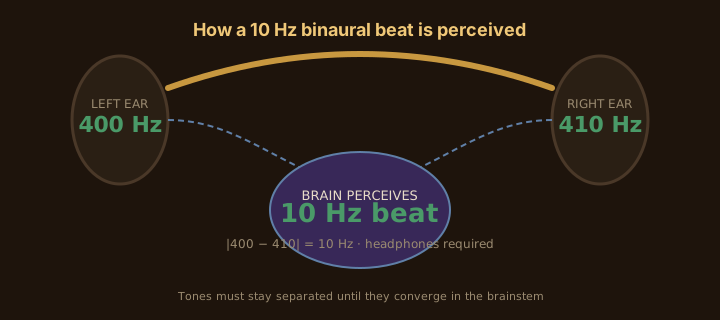
There is no third physical tone. I will keep saying that because product copy keeps unsaying it. A renderer can add pink noise, a rain bed, a guide voice. Those are extra layers. They are not the beat. The beat is the disagreement between the two carriers as heard, one in each ear.
Why speakers collapse the beat
Put the same two sines into a pair of studio monitors and the room becomes a mixer. Left and right meet in the air, in the walls, in your pinnae as a single acoustic field. You may hear acoustic beating — the physical cousin. You will not hear a clean binaural beat, because the two ears are no longer receiving two isolated carriers. The difference you designed on the pan pots has been summed by furniture.
Headphones keep the assignment. Left driver, left ear. Right driver, right ear. Isolation is the whole trick. Cheap cups can do this if both drivers work and the source stays stereo. That is a hardware sentence, not a boutique sentence. See headphones and cheap headphones can work. Bluetooth can also work when the codec and the device keep a stereo pair. Mono fold-down, one-ear listening, and car speakers are not a binaural path. The console is not broken when a Bluetooth speaker fails the test. The path is.
Speakers collapse the difference. If a page tells you to play “binaural beats” on a soundbar so the whole house can share them, the page is describing a house party, not a binaural beat.
Dove, Oster, and a long hallway
Heinrich Wilhelm Dove noted the phenomenon in 1839. The observation is old. The marketing is new. Gerald Oster’s 1973 Scientific American essay, “Auditory beats in the brain,” is the popular paper most of us inherited. Oster wrote about the illusion, about what the auditory system can compare, about why the effect is interesting. He did not write a wellness catalog. If you read him as a product spec, you are reading with a shopping cart.
Dove, H. W. (1839). Early observation of binaural beating. Oster, G. (1973). Auditory beats in the brain. Scientific American, 229(4), 94–102.
The hallway between 1839 and a Web Audio oscillator is long: analog generators, cassette programs, Hemi-Sync as a commercial language, consumer CDs, YouTube, now a browser console. The physics of two isolated carriers did not change. The adjectives did. I care about the physics. The adjectives can wait in the lobby.
Monaural is a different instrument
A monaural beat is what you get when two close tones are mixed into one stream — a speaker, a summed bus, a single driver. The interference is physical. You can hear it with one ear. You can hear it on a mono Bluetooth puck. That is a feature of the mix, not a feature of brainstem comparison.
Isochronic pulses are a third object: amplitude going on and off at a rate. Useful as a click. Useful as a trance tool for some listeners. Not a binaural beat. If a page treats binaural, monaural, and isochronic as three skins on the same animal, the page is selling a zoo ticket. The comparison essay in this desk will take that fork. For now, hold the distinction: binaural needs two ears and isolation. Monaural does not.
Where the comparison happens
The auditory system is already in the business of comparing ears. Localization, ITD, ILD — this is not a new organ invented for YouTube. The superior olivary complex is the name you will see in the papers for the early binaural meeting place in the brainstem. Two slightly different periodicities arrive. A beating percept can be generated from that disagreement. That is the established core. It is an illusion in the precise sense: a percept that is not a third pressure wave in the room.
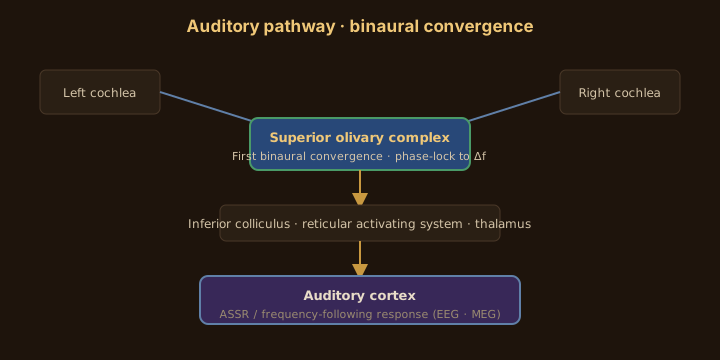
Cortical stories are a step up in ambition. Some EEG designs report frequency-following or ASSR-style activity related to the difference. Some designs do not. Lopez-Caballero and Escera (2017) is one of the papers I keep on the desk because it is willing to be limited. A definition page should not launder a mixed cortical literature into a guaranteed “brainwave match.” The match is a hope with a bibliography. The illusion is a fact with headphones.
How we generate the pair on this site — live oscillators, hard pan, visible numbers — is written in public at methodology. The desk itself is the Console. Definition first. Outcome studies later. Those are different floors of the same building. Do not take the elevator past the floor you asked for.
A practical check, the same one I use on other people’s files: pan or solo. Left should be one pitch. Right should be another. If both cups already contain the pulse, you are hearing a mixed object, not a binaural one. The calculator will name the difference. Your pan pot will tell you whether the difference was ever there.
Band labels are design targets
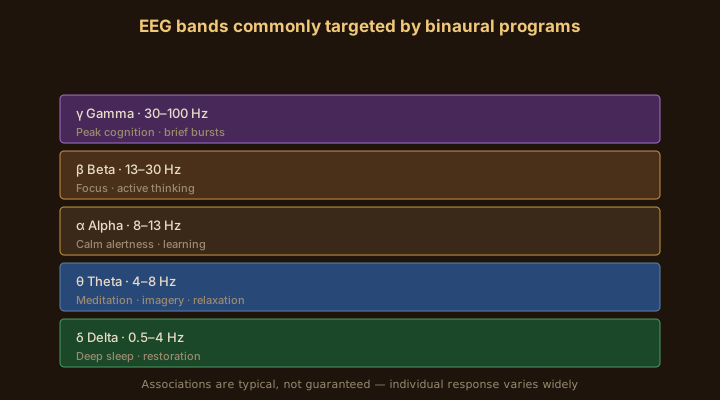
Delta, theta, alpha, beta, gamma are borrowed from EEG. They are useful shorthand for a difference frequency you chose. A 10 Hz difference can be called an alpha-range design. That does not mean your cortex will display a textbook alpha while you listen. It means the oscillator pair is aimed at a 10 Hz disagreement.
The interactive map at brainwave bands is the atlas. Use it as an atlas. Do not use it as a personality test. People pick theta because the word sounds like dusk. People pick beta because the word sounds like a deadline. Those are aesthetic choices. They can still be honest if you keep the sentence: this is a listening target, not a lab result.
Four levels of claim
The auditory illusion exists. Two isolated carriers, a perceived beat at |fL − fR|, superior olivary comparison. Headphones required. Speakers collapse it.
Some EEG FFR/ASSR literature reports following of the difference in some designs, some listeners, some electrode stories.
Whether a given difference changes sleep, focus, or mood in daily life is an outcome question with modest, heterogeneous trials. Not the definition.
A third tone in the room. A guaranteed EEG match. Downloaded knowledge. A cure hiding inside 6 Hz. Those are posters, not definitions.
If you leave this page with one object in your hands, let it be this: two carriers, one per ear, a pulse you perceive at the difference, cups on. Everything else is a later inquiry. The later inquiries are welcome. They are not this sentence.
What we still do not know
We still argue, in good faith, about how large a difference can be and still feel like a “beat” rather than roughness or a second pitch. Thirty hertz is a craft ceiling, not a cliff. Carrier preference is personal. Some listeners want 120 Hz. Some want 400. I will not pretend there is a single studio standard hiding behind a trademark.
We also do not know why some people barely perceive the pulse even with honest stereo and good isolation. Attention, hearing asymmetry, and expectation all sit in that gap. The definition still holds. The percept is not universal in strength.
Questions operators actually ask
What is a binaural beat in one sentence?
It is a perceived pulse at the absolute difference between two pure-tone carriers, one sent to each ear. There is no third physical tone in the room. Headphones keep the two carriers isolated so the comparison can happen.
Why do I need headphones?
Speakers mix left and right in the air, so both ears receive both tones. That can produce acoustic beating, which is a different instrument. A binaural beat needs isolation: left carrier to left ear, right carrier to right ear.
What carrier frequencies should I use?
A practical window is roughly 100 to 900 Hz, chosen for comfort and audibility. The beat is the difference, not the carrier. If the carriers feel harsh or woolly, move them before you chase a new band name.
Is the beat a real sound wave at 10 Hz?
Not in the room. Ten hertz as a pressure wave would be infrasound from a loudspeaker, which is not what this console is doing. The 10 Hz is the rate of the percept created by comparing 200 Hz and 210 Hz, for example.
Are delta and theta names proof of my brain state?
No. Those words are borrowed EEG labels used as design targets for the difference frequency. They name the oscillator pair you chose. They do not certify a lab trace.
How is this different from a monaural beat?
A monaural beat is physical interference in a mixed signal. You can hear it with one ear. A binaural beat is a comparison between isolated ears. If a track is identical left and right, it is not binaural.
Who described this first?
Dove noted binaural beating in 1839. Oster’s 1973 Scientific American essay, Auditory beats in the brain, is the popular modern explanation most consumer copy quietly inherits. Neither paper is a product brochure.
Keep reading
Educational listening notes from a working audio engineer. Not medical advice. Not a medical device. Headphones required for a true binaural beat. Methodology · About · Garcia-Argibay 2019