Astral AP-02
AP-02 // WBTB
AP-02 // WBTB — a sleep-schedule technique used in lucid-dream and OBE practice. BBM did not invent it. We do not publish “three days” as a result. The audio is a short bed after the wake window, then off.
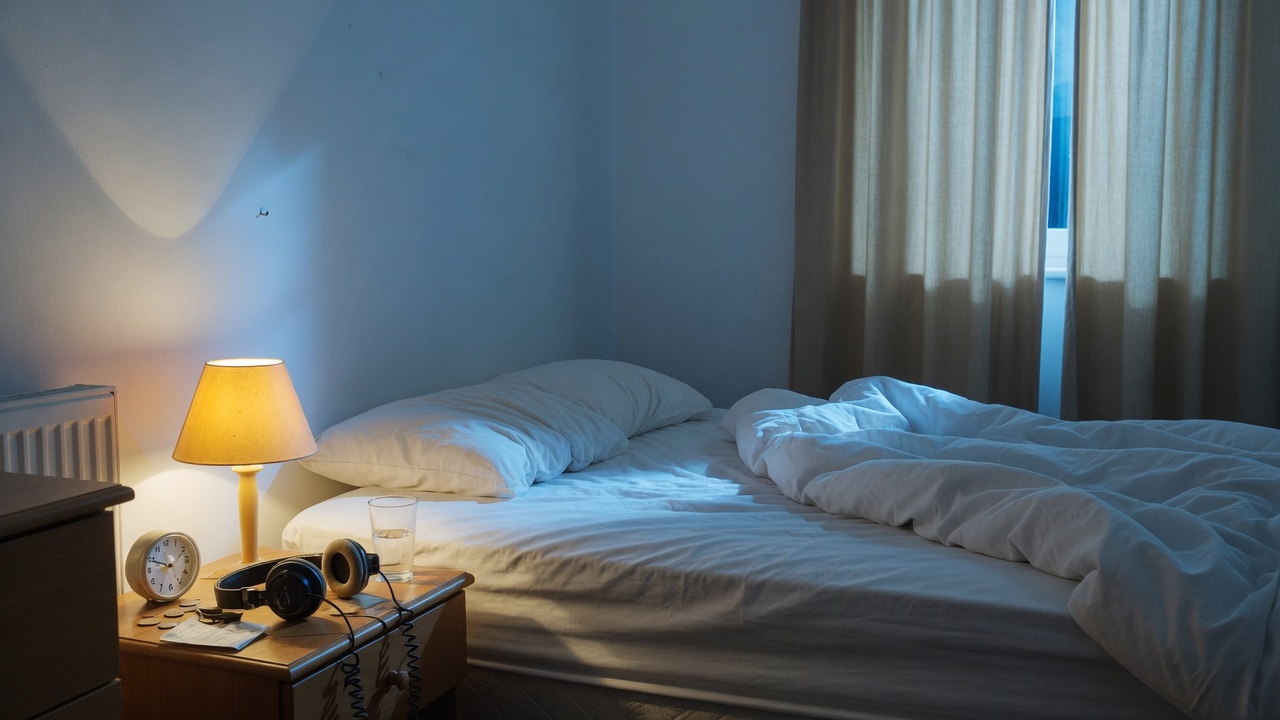
What WBTB is and is not
Wake-back-to-bed is a schedule, not a frequency. An operator sleeps several hours, wakes, stays up briefly — long enough to be actually awake, not long enough to start the day — and returns to bed with an intention: lucidity, a chosen method, or simply attention at the sleep edge. The method is older than this console. Lucid-dream researchers and practitioner cultures used it because the later night is richer in REM, and because a brief waking can raise the odds of insight into the dream. BBM did not invent that. We supply a short stereo bed after the wake window, then we turn it off.
What this door is not: a BBM invention dressed as a discovery. A three-day training guarantee. A license to treat sleep loss as virtue. A clinical treatment for insomnia — it can fragment sleep, which is the opposite of a sleep-medicine goal. A claim that 7 Hz causes projection. A cousin of Raduga’s “three days” advertisement; that claim is a school’s marketing, and this desk will not republish it as a result. If you want Raduga’s taxonomy as culture, that is AP-05 Phase, and even there the three-day frame stays labeled as advertisement. Safety still owns this door.
Stumbrys, Erlacher, Schädlich & Schredl (2012) reviewed lucid-dream induction. WBTB-like tools appear there among others — not as miracles. LaBerge (1981, 1985) made lucidity an experimental object; that is not extra-somatic proof. WBTB is a shared practice between lucid-dream research and OBE culture, not identity. Semantics. Stumbrys 2012.
Audio after the wake window
After the wake window, not before it, and not all night: carrier approximately 80 Hz, beat approximately 7 Hz — a theta-range difference — for about 15 minutes, then off. Headphones. Low volume. The tones are a bed for returning to sleep with attention, not a lullaby you leave running into a work alarm. When the fifteen minutes end, the audio ends. If you are still awake, you may continue the method in silence. If you are asleep, the machine should not keep talking.
A short theta-range difference is a listening choice for a later night already near REM. It is not a key to a plane. Oster (1973) still governs the headphones. Speakers mix the ears in the air. History: Binaural history. Paralysis and lucidity as facilitators for some OBEs: Moix, Baldaccini & Isern (2025), on the research desk.
How to run the night
Only on a night that can absorb a broken sleep. Set a gentle alarm after several hours — commonly four to six, the exact number less important than actually waking. Sit up. Lights low. Stay up briefly: a few minutes of ordinary waking occupation, not a second workday and not a phone spiral. Intention in one sentence you can remember. Return to bed. Headphones. Start the ~80 Hz · 7 Hz bed. Fifteen minutes. Off.
Intention can be modest. “If I dream, I will notice I am dreaming.” “I will stay with the body-map as I fall.” “I will try a roll if the body-map argues.” Do not load the return with a travel itinerary you will then mistake for memory. If a method from the encyclopedia is in play — rope, roll, target — name it before you lie down so the journal does not have to guess. Craft cards: Methods.
When you next wake, or when morning arrives, run AP-06 Return before the decay finishes its work. False awakenings are common around interrupted sleep. A dream of having written notes is not notes. Physical tests (reading text twice, a light switch) are imperfect and still better than certainty. If paralysis arrives, you named it in advance. Breathe. Wait. It passes. Sit up when you can. Do not immediately re-enter the protocol to “finish the job.”
What to journal
Clock times: sleep onset if known, wake time, length of the wake window, return time, audio on/off, final waking. Sleep quality in ordinary words. Method: AP-02 plus whatever intention or technique you actually used, not the one you meant to use. Audio: ~80 Hz · 7 Hz · ~15 min, then off — or the modification. Dream content, lucidity yes/no/partial, felt location of the self, paralysis, hypnopompia. Experience class. Confidence. Target if any.
Interpretation in a separate sentence. “I became lucid in a hallway” is one report. “I left my body and walked the physical hallway” is another. Do not silently replace the 3 a.m. definition with the noon doctrine. Rapid decay is ordinary; that is why the notes are not optional. How to write without laundering a night into proof: Field reports.
Failure modes
Running WBTB before a drive, a shift, or caretaking. Stacking it nightly as a lifestyle. Treating insomnia as a badge. Leaving the tones on until morning so the “theta” can “work.” Using the wake window to scroll until the later night is only sleep debt. Confusing a vivid dream after interruption with a verified exit. Coaching yourself in terror to complete a separation. Borrowing Raduga’s three-day frame and calling it this protocol. Skipping Return because the alarm already owns you — in which case you should not have run AP-02 at all.
A quieter failure: treating a blank night as disproof of lucidity research, or a single lucid as extra-somatic travel. Stumbrys et al. reviewed induction tools, not metaphysics. Write the class of experience you had. Leave the scientific claim unfinished unless you tested it.
Sleep debt and stop rules
Do not run this if you must drive or work after. Do not use deliberate severe sleep deprivation as a hack. Sleep loss impairs judgment, mood, and driving. It is not a credential. Stop if distressed. Volume comfortable. No alcohol or recreational-drug recommendation from this desk. No medical claims. Sleep paralysis is a REM-related phenomenon named in advance; recurrent, impairing events belong with a clinician, not with a protocol page. Full standing rules: Safety. Cluster of states: Sleep, lucidity, paralysis.
WBTB is the right door when the later night is available and the morning is not a vehicle. It is the wrong door when you are bargaining with sleep you do not own.
ENGAGE WBTB on the Experience tab
Bibliography
- Stumbrys, T., Erlacher, D., Schädlich, M., & Schredl, M. (2012). Induction of lucid dreams: a systematic review of evidence. BBM reading
- LaBerge, S. P., Nagel, L. E., Dement, W. C., & Zarcone, V. (1981). Lucid dreaming verified by volitional communication during REM sleep. Perceptual and Motor Skills, 52(3), 727–732. BBM reading
- LaBerge, S. (1985). Lucid Dreaming.
- Oster, G. (1973). Auditory beats in the brain. Scientific American, 229(4), 94–102. PMID 4727697
- Moix, J., Baldaccini, S., & Isern, M. (2025). Out of body experiences: scoping review. EXPLORE, 21(4), 103196. PMID 40540759
Educational only. Not medical advice. Headphones required for a true binaural beat. Not affiliated with the Monroe Institute. Experience is not interpretation is not a scientific claim.