Declassified Technique language
Hemi-Sync and brainwave coherence in FOIA
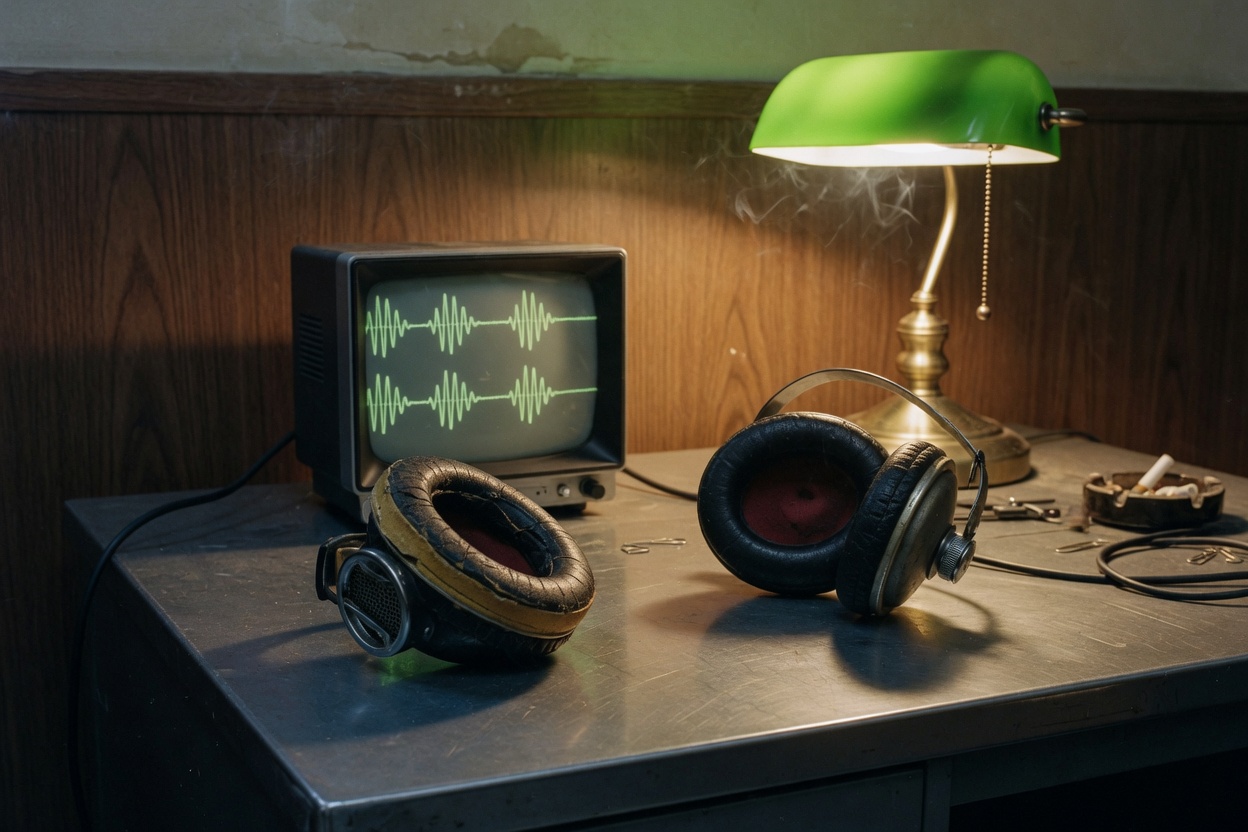
The Gateway assessment talks about bringing the hemispheres into a stronger, more coherent output. That sentence is the shortest official bridge from declassified paper to a modern binaural instrument.
Hemi-Sync, as Robert Monroe described it, was not one magic hertz. It was a stack: binaural beats and other layers arranged so a listener might experience the two hemispheres as working together. In the 9 June 1983 INSCOM assessment (CIA-RDP96-00788R001700210016-5), LTC Wayne M. McDonnell repeats that ambition in staff English — amplitude, frequency, coherence of brainwave output between hemispheres. That sentence is the shortest official bridge from declassified paper to a modern stereo instrument.
Where the language comes from
The percept is older than the brand. Dove (1839) described dichotic beats; Oster (1973) put them back in print. Frequency-following language — the idea that the brain’s electrical rhythms can be nudged by a periodic stimulus — was already in the neuroscience air of the 1970s. Monroe’s contribution, in the files, is packaging: headphones, a voice, numbered Focus states, and a claim of hemispheric “synchronization.” McDonnell’s contribution is translation for a commander who needed to know whether that package was worth a look.
Two meanings of “coherence”
In acoustics, two tones a few hertz apart produce a beat you can hear in the head. In EEG, coherence is a statistical relationship between electrode channels. The FOIA text slides between those registers. That slide is historically interesting and scientifically unfinished. There is no declassified clinical database proving that Hemi-Sync “locks” a brain to a band the way a metronome locks a drummer. There is a paper that wanted the metaphor, and a civilian product that still uses headphones.
What you can still test
Isolate the ears. Set a carrier and a difference you can name (Oster’s useful range is roughly below a few tens of hertz for a clear binaural percept). Sit still. That is psychoacoustics plus attention. It is not Monroe’s full stack, not a Focus initiation, and not a reconstruction of INSCOM.
Editorial reading of declassified material. The official PDF is authoritative. Not medical, legal, or intelligence advice. Not a claim that consumer audio recreates historical units. The live lab is observational, not proof.