Console · About · Articles · 40 Hz binaural beats
40 Hz
40 Hz binaural beats
Forty hertz is a real research frequency in sensory stimulation. Consumer binaural YouTube is not the MIT GENUS protocol.
The honest answer
A 40 Hz binaural session on this console is a 40 Hz difference between ears. MIT Tsai / GENUS work studied 40 Hz sensory stimulation — typically click trains and/or light flicker — not consumer binaural YouTube. We do not recreate that protocol. We do not claim Alzheimer’s outcomes.
What 40 Hz actually is
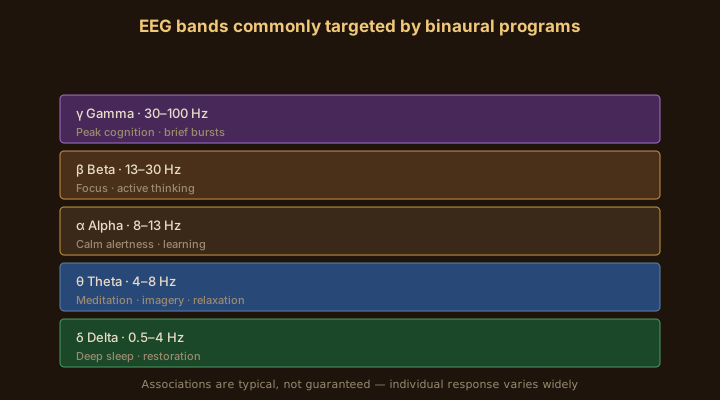
Forty hertz is a rate. In EEG talk it sits in the gamma neighborhood, often discussed above roughly 30 Hz, with popular gravity around 40. In audio it can mean several different signals that share a number and almost nothing else. That is the first honesty this inquiry needs.
A 40 Hz binaural beat is a 40 Hz difference between two continuous carriers, one per ear. Left 200 Hz, right 240 Hz. The equation is the same as any other pair: the beat equals the absolute difference. Headphones required. The percept is a fast shimmer, not a kick drum. Some listeners find it stimulating. Some find it irritating. Neither reaction is a diagnosis.
A 40 Hz click train is a different object: brief pulses repeating forty times a second, often presented to both ears, sometimes in the room, sometimes with light flicker at the same rate. A 40 Hz light flicker is visual. These are the kinds of sensory stimuli used in many laboratory “40 Hz” protocols. They are not your YouTube mix, and they are not what this console’s binaural oscillators do when you type 40 into the beat field.
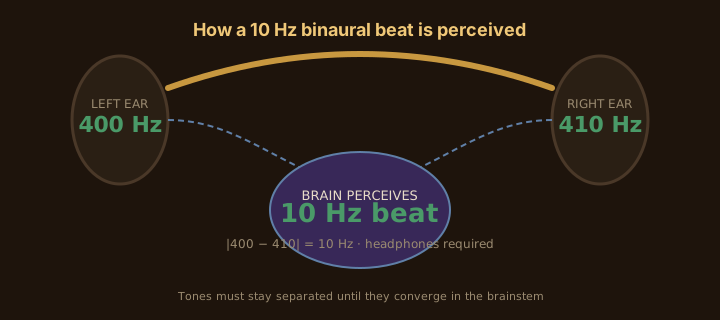
Forty hertz is a real research frequency in sensory stimulation. Consumer binaural YouTube is not the MIT GENUS protocol.
If you want the number as a listening experiment on this site, start at 40 Hz and the research notes at gamma 40 Hz research. Culture and overclaim live next door at gamma research culture. Mechanism first: how binaural beats work.
What GENUS papers studied — and what they did not
GENUS is an acronym from the Tsai laboratory at MIT: Gamma ENtrainment Using Sensory stimuli. The public papers that made 40 Hz famous outside audio forums used click trains and/or light flicker at 40 Hz in tightly specified lab protocols, first in animals and then in human studies that are still being read, replicated, and argued. That literature is about sensory stimulation at a gamma-range rate. It is not a consumer binaural playlist.
I will be blunt, because the internet is not. Those papers are not a license to play a 40 Hz binaural YouTube video at a parent. They are not a home protocol you can copy with a browser oscillator. They do not make this console a clinic. Binaural Beat Machine is a true-stereo instrument. It is not GENUS. It does not claim Alzheimer’s outcomes. It does not imply that ENGAGE is that protocol with a nicer skin.
Unsupported at home: reversing dementia, “clearing amyloid,” or recreating a Tsai-lab sensory protocol with a binaural YouTube mix or this console. If a family member needs care, they need care. Audio is not that appointment.
I have been an audio engineer since 2010. I can generate a stable 40 Hz interaural difference in my sleep. That skill is not a neurology degree. When a thumbnail steals the prestige of a Picower Institute paper and pastes it onto a sine wave, the theft is conceptual. The click train is not the binaural pair. The flicker is not the headphone. The lab is not your bedroom.
| Signal | What it is | Where you meet it |
|---|---|---|
| 40 Hz binaural | Continuous carriers, 40 Hz apart, isolated L/R | This console, true-stereo generators |
| 40 Hz click train | Pulses at 40 per second | Many lab auditory protocols |
| 40 Hz flicker | Light modulating at 40 Hz | Many GENUS-style visual protocols |
| YouTube “40 Hz” | Unknown mix, unknown stereo, unknown limiter | A caption, not a methods section |
What a 40 Hz session on this console actually is
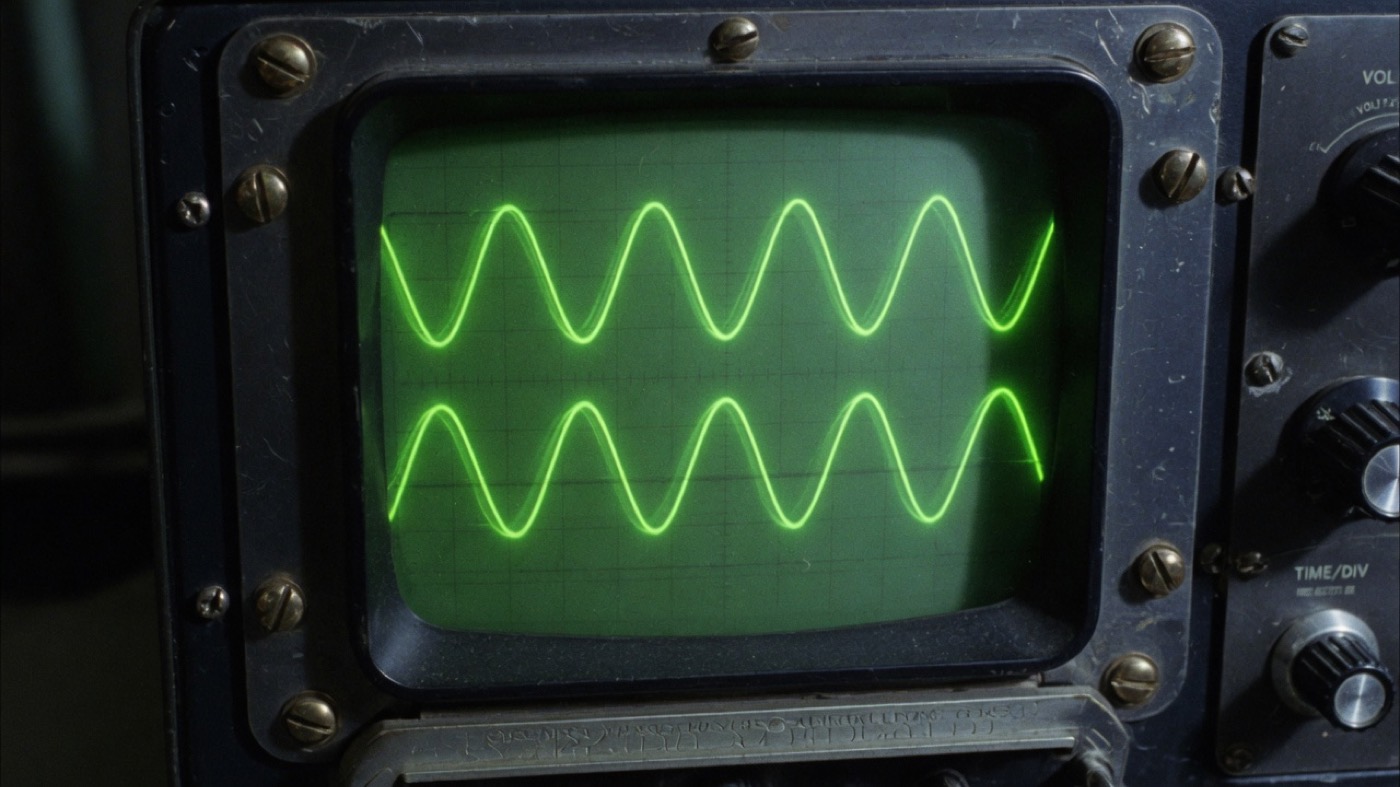
You set a beat of 40 Hz. Two oscillators, hard-panned. The difference is forty. Headphones on. You are running a listening experiment: a gamma-range binaural difference, at a volume you can live with, for a length you will actually finish. That is the whole claim. See methodology for the engineering, and open the Console if you want the pair rather than the essay.
Fast beats can feel stimulating. Keep sessions short if the field feels tight. Step down toward beta or alpha if your jaw finds the shimmer. Louder is not more gamma. Louder is more risk. The calculator will show you left and right; the waveform explorer will show you a picture. Those are tools. They are not the homepage, and they are not a lab protocol.
Carriers still matter. A 40 Hz difference on a 200 Hz bed is a different listening object than a 40 Hz difference on a piercing 2 kHz bed. Stay listenable. Oster’s public-science point still holds: the binaural percept prefers modest carriers. Extreme carriers are a dare. This console’s job is a pair you can sit with, not a pain practice.
What binaural-gamma EEG papers actually measured
Separate from GENUS, there is a smaller binaural literature that asks whether a gamma-range binaural difference leaves a trace in EEG or behavior. Jirakittayakorn and Wongsawat reported EEG features associated with specific beat rates, including theta-range and gamma-range designs, in controlled lab listening. That is a narrow, useful scale: one frequency, one montage, one question. It is not a disease paper. If you park this console at 40 Hz, you are choosing a neighbor of those listening protocols. You are not repeating them.
López-Caballero and Escera (2017) reported a failure to enhance EEG power and emotional arousal under their binaural-beat conditions. Keep that paper on the desk. Settled fields do not still publish careful failures. A null does not erase Oster’s percept. A positive EEG trace does not mean your cortex has been “tuned to gamma” for the afternoon.
Garcia-Argibay, Santed, and Reales (2019) pooled 22 studies and 35 effect sizes on cognition, anxiety, and pain, with a modest overall Hedge’s g around 0.45. That meta-analysis is not a 40 Hz paper. It is the best modern map of outcome studies, and it still comes with heterogeneity and small-N bruises. DOI 10.1007/s00426-018-1066-8. Do not paste it onto a dementia thumbnail.
Oster, G. (1973). Auditory beats in the brain. Scientific American. Jirakittayakorn & Wongsawat — lab EEG at specified beat rates, including gamma-range designs. López-Caballero, F., & Escera, C. (2017). Binaural beat: a failure to enhance EEG power and emotional arousal. Front. Hum. Neurosci. Garcia-Argibay et al. (2019), DOI 10.1007/s00426-018-1066-8.
40 Hz is a real rate. A binaural 40 Hz pair is a 40 Hz interaural difference. Headphones required. GENUS-style papers used sensory click trains and/or flicker, not consumer binaural YouTube.
Lab EEG work can show band-related features for specified beat rates in specified protocols. Sensory 40 Hz is an active research program. That is not the same as a home binaural session.
Whether a consumer 40 Hz binaural session changes attention, mood, or EEG outside the lab. Fast beats feel intense to some listeners and empty to others.
Reversing dementia at home. Recreating MIT GENUS with this console or a playlist. Intelligence upgrades. Permanent rewiring from a thumbnail.
How I would listen, if I were curious
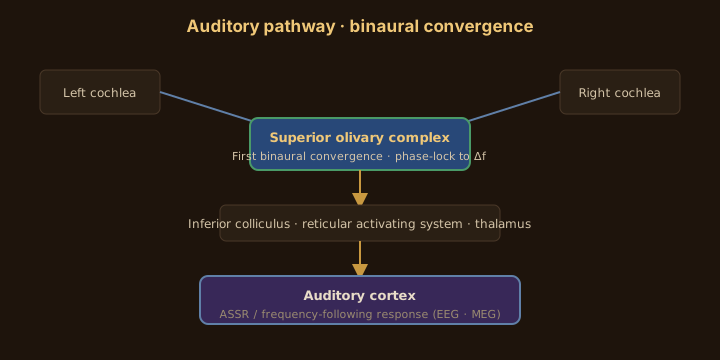
Curiosity is allowed. Fantasy methods sections are not. If you want to hear a 40 Hz binaural difference, use stereo headphones, a moderate volume, and a short timer. Confirm the path is true stereo — phone speakers and some Bluetooth folds will give you a harsh acoustic beat or nothing honest. Read the definition if the illusion still feels like a third speaker in the room.
I do not run 40 Hz as a default work bed. Studying and ordinary focus usually live lower, in alpha and beta furniture. Gamma-range shimmer is a peak-oriented experiment for people who already know the instrument. If it feels wrong — headache, agitation, nausea — Halt. Photosensitive or seizure-prone listeners should be cautious with strong rhythmic stimulation of any kind and talk with a clinician. I do not give medical advice. I generate pairs.
A word on volume, because gamma culture loves intensity. The beat is a difference, not a sound-pressure contest. WHO and NIOSH hearing-conservation numbers exist for occupational noise — 85 dBA over eight hours as a common reference — and consumer listening should sit comfortably below any of that theater. If you cannot hear the shimmer, check stereo before you crank. If you can hear it and it hurts, Halt. Photosensitive and seizure-prone people should be cautious with strong rhythmic stimulation, visual or auditory, and consult a clinician. I will not pretend a sine wave is a screening tool.
I also will not pretend that every 40 Hz file on the internet is a binaural pair. Many are isochronic pulses, mixed acoustic beats, or music beds with a caption. Isochronic and monaural are different signals; they can be interesting, and they are not this console’s binaural path. If you need the three-way split, it lives elsewhere on this desk. For this inquiry, the only sentence that matters is: a binaural 40 Hz session here is two live oscillators, forty hertz apart, headphones, a timer.
People ask whether they should run 40 Hz overnight, in a car, or for a child. Overnight in cups is a comfort and hardware question, not a gamma flex — and sleep programs are a different inquiry. Do not drive on a drowsiness design. Children are not unsupervised operators of this instrument. None of those answers change because the number is 40 instead of 10. The number is not a permission slip.
The honest sentence is small enough to fit on a tape box: this is a 40 Hz difference between ears. It is not a hospital. It is not GENUS. It is not a promise. Headphones on, if you still want the experiment. Silence, if you do not.
What we still do not know
We still do not know how much of the public 40 Hz story will survive replication, how binaural gamma compares with click-train or flicker protocols, or whether any consumer headphone session maps onto the sensory-stimulation literature at all. I will update this desk when the papers do. Until then, the number is a listening target, not a hospital.
Questions operators actually ask
Is a 40 Hz binaural beat the same as MIT 40 Hz therapy?
No. GENUS-style lab work typically used 40 Hz click trains and/or light flicker in specified protocols. A binaural 40 Hz pair is two continuous tones, 40 Hz apart, over headphones. This console is not that protocol.
Can 40 Hz binaural beats reverse dementia at home?
That claim is unsupported. Do not treat a YouTube mix or this generator as a stand-in for clinical care. If someone needs a clinician, they need a clinician.
What am I actually hearing at 40 Hz?
A fast difference between left and right carriers. Example: 200 Hz left, 240 Hz right. The beat is the difference. Headphones required. It can feel like a shimmer rather than a slow pulse.
Should I use 40 Hz to study or focus?
Not as a default. Ordinary study and focus beds usually live in alpha and beta. Forty hertz is a gamma-range experiment. Keep it short if it feels tight.
Do EEG studies prove consumer 40 Hz binaural works?
Lab papers at specified beat rates, including Jirakittayakorn and Wongsawat, are not the same as your playlist. López-Caballero and Escera reported a failure to enhance EEG power under their conditions. Mixed is the honest word.
Are headphones required?
Yes, for a binaural 40 Hz pair. Speakers mix the carriers in the air. Some phone playback is mono. If the path is not stereo, you are not running the experiment you think you are.
Where can I try 40 Hz on this site?
The 40 Hz frequency page, the Console, and the research notes. The calculator and waveform explorer are tools, not a GENUS machine.
Keep reading
Educational listening notes from a working audio engineer. Not medical advice. Not a medical device. Headphones required for a true binaural beat. Methodology · About · Garcia-Argibay 2019