Console · About · Articles · Binaural beat frequencies
Atlas
Binaural beat frequencies
Delta, theta, alpha, beta, gamma are borrowed EEG labels. They name a listening target. They do not promise your lab EEG will follow.
The honest answer
Band names are design targets: delta 0.5–4 Hz, theta 4–8, alpha 8–13, beta 13–30, gamma ~30–100 with 40 Hz called out separately. Carrier is pitch; beat is the difference. More hertz is not better. Headphones required. No skeleton key.
Bands as design targets, not guarantees
Delta, theta, alpha, beta, gamma are borrowed EEG labels. On this desk they name a listening target: the beat frequency I ask the oscillators to hold. They do not promise that a lab would print your cortex in that band. Charts disagree at the borders by a hertz or two. Nobody’s neurons file a complaint. If a caption says a number will “give you” a state, it has confused a menu for a meal.
More hertz is not better. It is a different neighborhood. Sometimes the wrong one.
The interactive map is brainwave bands. The myth to retire first is the one magic frequency myth. The arithmetic that keeps carrier and beat from swapping jobs is the binaural beat calculator. This inquiry is the atlas in magazine form.
The atlas I actually use
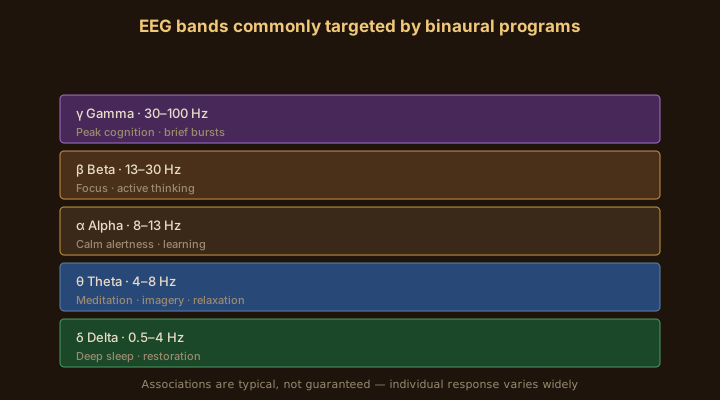
| Band | Beat range | How I use it on this desk |
|---|---|---|
| Delta | 0.5–4 Hz | Rest-adjacent listening; easy to drift; not a sedative |
| Theta | 4–8 Hz | Common sit target; inward; not an enlightenment gate |
| Alpha | 8–13 Hz | Eyes-soft, open awareness, a calm desk |
| Beta | 13–30 Hz | Work bed in the lower part; upper part can feel edgy |
| Gamma | ~30–100 Hz | A wide, culturally loaded range; not a flex |
| 40 Hz | called out inside gamma | A real research frequency in sensory stimulation; consumer binaural YouTube is not the MIT GENUS protocol |
Borders are conventions. Some charts put alpha to 12, some to 13; some start beta at 12, some at 13; gamma’s floor moves depending on who is teaching the intro slide. I use 8–13 for alpha and 13–30 for beta because I had to pick a ruler and stick to it on the console. If your teacher uses 12.5, we are still in the same city.
Forty hertz gets its own row because search culture glued it to gamma marketing. There is a serious sensory-stimulation literature around 40 Hz that is not “press ENGAGE on a phone.” The dedicated inquiry is 40 Hz binaural beats. Do not paste that literature onto a browser pair and call it a protocol.
Carrier versus beat
Two numbers, two jobs. Mix them up and every caption starts lying. Carrier is the audible pitch in one ear — 200 Hz, say. The other ear holds 208 Hz. Beat is 8 Hz, the difference. Alpha-as-design-target is a statement about 8, not about 200. Solfeggio slogans, concert pitch, and a theta difference do not compete. They live on different axes.
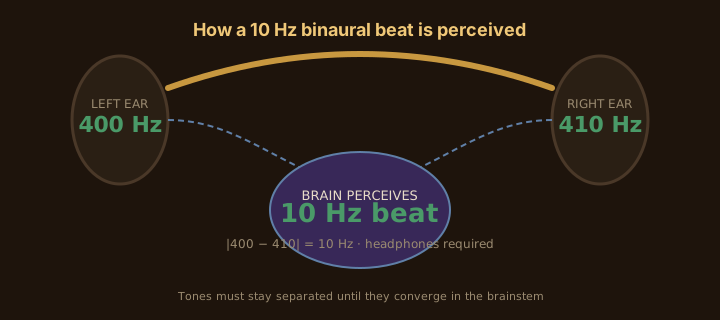
On this console I set carrier for comfort and beat for the hour. A biting carrier will wreck a beautiful beat. A sleepy beat will wreck a work hour. The operator procedure is how to use binaural beats. The physics is how binaural beats work. The definition demo is what are binaural beats. Engineering is methodology.
Headphones remain required for the binaural object. Isochronic pulses do not require them; that is a different signal, compared in binaural vs isochronic vs monaural. If you only remember one row from this atlas, remember: beat is the band. Carrier is the pitch. Isolation is the method.
More Hz is not better
Gamma-as-flex is a gym culture that wandered into audio. Climbing the chart because it looked like a scoreboard is how people overstimulate and blame the method. High beta can feel tight, anxious, over-caffeinated. Sleep does not live there. A sit usually does not either. Match the band to the hour: work, sit, night. Step down without shame. This console does not keep a high-score table.
If a session jitters, step toward alpha or stop. Stacking espresso, loud volume, and a 25 Hz difference is a dare. HALT is a control. The atlas is a menu. You are allowed to order something quieter.
Meditation sits on this desk usually live in theta 4–8 or alpha 8–13. That essay is binaural beats for meditation. Evening tightness is not a request for more hertz; see binaural beats for anxiety before you brighten the pair. The headphones guide still applies: isolation, modest volume, both ears.
What the ledger covers — and what it does not
Oster (1973) established the public explanation of the percept. The beat is a comparison, not a third speaker. Garcia-Argibay, Santed, and Reales (2019) pooled 22 studies and 35 effect sizes and found a small-to-moderate average effect (g ≈ 0.45) across mixed outcome domains. That paper also notes that bands are not interchangeable: different difference rates can move different tasks in different directions. It does not hand you a magic integer. López-Caballero and Escera (2017) failed to enhance EEG power and emotional arousal under their conditions. Keep that null in the atlas. A band name on a knob is not a cortical lock.
Oster, G. (1973). Auditory beats in the brain. Scientific American, 229(4), 94–102.
Garcia-Argibay, M., Santed, M. A., & Reales, J. M. (2019). Efficacy of binaural auditory beats in cognition, anxiety, and pain perception: a meta-analysis. Psychological Research, 83(2), 357–372. DOI 10.1007/s00426-018-1066-8. Map.
López-Caballero, F., & Escera, C. (2017). Binaural beat: a failure to enhance EEG power and emotional arousal. Frontiers in Human Neuroscience, 11, 557.
Beat frequency is the difference between isolated carriers. Band names are chart conventions. Headphones required for binaural.
Using those names as design targets for a session: delta for rest-adjacent, theta/alpha for a sit, low beta for a desk.
Whether your EEG follows the target. Outcome effects by band. 40 Hz consumer files versus lab sensory protocols.
One magic frequency, “more Hz is better,” guaranteed cortical lock, and enlightenment or medical claims attached to a number.
How to pick a number tonight
Name the hour. If it is a sit, start in theta or low alpha. If it is a desk, try low beta and notice whether you tighten. If it is rest-adjacent, delta is a design target, not a sleeping pill — and you still do not drive with it. Set the carrier so the pitch is easy. Set a length. Open the Console. ENGAGE. Leave the atlas alone mid-session. After HALT, keep the number or change it tomorrow. A week of one target teaches more than a night of shopping.
If you want the pair computed instead of guessed, use the calculator: carrier plus beat into left and right, or two tones into a difference. Then listen. The map is not the territory. The cups are.
I have been choosing these numbers on benches since 2010. The longer I do it, the less I believe in a skeleton key and the more I believe in a labeled menu, a comfortable carrier, and an operator who will HALT when the hour is wrong. That is the whole atlas.
A worked pair
Carrier 180 Hz. Beat 6 Hz. Left 177, right 183 — or 180 and 186, depending how you split. The sit-shaped target is 6, a theta design. The pitch you hear is around 180. If you hate 180, you change 180, not 6. If 6 feels like a nap you did not ask for, you change 6, not 180. Two knobs. Two jobs. The calculator will print the split if you do not want to do the arithmetic in your head.
Another pair: carrier 200, beat 10. Low alpha as a design target. Eyes-soft desk, or a sit that still wants the room. Another: carrier 160, beat 2. Delta as a rest-adjacent target. Bed, not a highway. Another: carrier 220, beat 18. Low beta as a work bed. If 18 tightens your jaw, you do not “level up” to 28. You step down. The atlas is not a scoreboard.
Forty hertz, without the poster
People ask for 40 because a paper, a podcast, or a thumbnail told them gamma is the good neighborhood. There is a serious literature around 40 Hz sensory stimulation — light, sound, carefully built lab protocols. That literature is not a browser oscillator pair with a stock photo of a brain. I will generate 40 Hz as a difference if you ask the console to. I will not tell you that you just ran GENUS in your living room. The dedicated inquiry exists so this atlas can stay an atlas.
Gamma as a whole (~30–100) is a wide street. Most consumer files that say gamma mean “a high number.” High numbers can feel tight. Tight is information. If you came for a sit, you probably wanted theta or alpha. If you came for a desk, you probably wanted low beta. If you came to collect integers, you wanted a hobby, and you can collect them here — just do not confuse the collection with a life.
Use the band map, the calculator, and a week of one target. Then keep your number. This console will let you change it in a second. That flexibility is the point. The point is not a magic hertz. The point is an operator who knows which axis they are turning. Delta 0.5–4, theta 4–8, alpha 8–13, beta 13–30, gamma about 30–100, 40 Hz called out so the poster does not swallow the atlas. Carrier for comfort. Beat for the hour. Headphones on both ears. ENGAGE. Stay. Then HALT like a person who chose a number on purpose.
What we still do not know
We do not know that your EEG will follow the beat you chose. We do not know the “right” border between alpha and beta for your skull. We do not know how much of a 40 Hz conversation belongs to consumer binaural audio versus sensory-stimulation labs. Charts are menus. Individual differences are large. If a number feels wrong, it is wrong for the hour — even if a caption loved it.
Questions operators actually ask
What frequency should I use?
There is no skeleton key. Match the hour: theta or low alpha for a sit, low beta for a desk, delta as a rest-adjacent target. Set carrier for comfort. Try one number for a week instead of shopping all night.
What is the difference between carrier and beat?
Carrier is the audible pitch in one ear. Beat is the difference between ears. Alpha-as-a-target is a statement about the difference, not about the pitch. Mix them up and captions start lying.
Is a higher frequency more powerful?
No. More hertz is a different neighborhood. High beta can feel edgy. Gamma-as-flex is gym culture. Match the band to the job.
What about 40 Hz?
Forty hertz is a real research frequency in sensory stimulation. Consumer binaural YouTube is not that protocol. This atlas calls 40 Hz out inside gamma so the words stay honest.
Do the band borders matter to the hertz?
Borders are conventions. Charts disagree by a hertz or two. I use delta 0.5–4, theta 4–8, alpha 8–13, beta 13–30, gamma about 30–100 so the console has a ruler. Close is close.
Do I need headphones to hear these frequencies?
To hear them as a binaural beat, yes. Isochronic pulses are a different signal and do not require headphones. Speakers collapse the binaural object.
Where can I set these on Binaural Beat Machine?
Open the Console, set carrier and beat, or use the calculator to turn a target into left and right. Headphones on. ENGAGE. Leave the knobs alone until HALT.
Keep reading
Educational listening notes from a working audio engineer. Not medical advice. Not a medical device. Headphones required for a true binaural beat. Methodology · About · Garcia-Argibay 2019