Console · About · Articles · Binaural beats for anxiety
Anxiety
Binaural beats for anxiety
Some trials report modest state-anxiety shifts. That is not a panic protocol, and it is not a reason to skip care.
The honest answer
Some trials report modest state anxiety shifts — Padmanabhan 2005 in a preoperative wait; Garcia-Argibay 2019 in a pooled analysis (22 studies, 35 effect sizes, g ≈ 0.45). That is not a panic protocol, and not a reason to skip care. Not a treatment. If someone is in crisis, they get care, not a frequency.
Honest framing, not a protocol
People type “binaural beats for anxiety” when they want the edge off. I understand the search. I will not pretend this console is care. Some trials report modest shifts in state anxiety — how wound you feel in the hour, in a waiting room, after a stressor. That is not the same object as trait anxiety or panic. It is not a reason to skip a clinician. If someone is in crisis, they get care, not a frequency.
A listening arc can be a designed hour. It is not a medicine, and I will not sell it as one.
I am an audio engineer, industry since 2010. I can tell you how to build a true-stereo downshift, how loud to run it, and which bands tend to feel edgy. I cannot tell you that 6 Hz will take apart a panic. The longer research map is binaural beats anxiety research. The designed listening arc on this site is Anxiety Unwind — a program, not a prescription. Not a treatment. If the hour is a crisis, you already know the next step and it is not a knob.
If you are in crisis, get care. Local emergency services, a crisis line, a person in the room. Do not sit alone with a generator and wait for a number to rescue you. This machine is audio. Audio is not a substitute for help.
State versus trait
State anxiety is the weather. Trait anxiety is the climate. Most binaural-beat trials that mention anxiety are measuring the weather: a pre-operative wait, a lab stressor, a short self-report scale after minutes of audio. That is a legitimate research object. It is also a much smaller claim than “this frequency rewires how you are.” When a landing page blurs the two, it is selling past the ledger. I will not give your life a clinical label from a browser oscillator. I will describe a listening hour.
- State — how you feel in this hour. Some modest, mixed experimental signals exist.
- Trait — how you tend to be across months and years. Not what a 20-minute YouTube file is for.
- Panic — a clinical event. This desk has no panic protocol. Soft lighting and a slow pair are not an emergency plan.
I will use the word unwind for a designed listening arc. I will not use the language of a clinic. If a session tightens you, HALT. If a session helps you take the next ordinary breath, that is a small, legitimate use of a tool. Keep it in that size.
| Object | What it is | What this desk will say |
|---|---|---|
| State | Weather of the hour | Some modest, mixed trial signals exist |
| Trait | Climate of months | Not what a 20-minute file is for |
| Panic | A clinical event | No protocol here. Get care, not a frequency |
What trials actually report
Padmanabhan, Hildreth, and Laws (2005) ran a prospective randomised study of binaural-beat audio for pre-operative anxiety, published in Anaesthesia. The setting is a hospital corridor of the mind: waiting, not meditating for sport. They report anxiety-scale changes in that context. Adjunct, not anesthetic. One scale, one era, one waiting room. I keep it on the shelf because it is the right genre for “does this do anything when people are actually scared.” I do not keep it as a license to market a browser oscillator as pre-op medicine.
Padmanabhan, R., Hildreth, A. J., & Laws, D. (2005). A prospective, randomised, controlled study examining binaural beat audio and pre-operative anxiety in patients undergoing general anaesthesia for day case surgery. Anaesthesia, 60(9), 874–877. PMID 15710011.
Garcia-Argibay, Santed, and Reales (2019) pooled 22 studies and 35 effect sizes on cognition, anxiety, and pain perception. The average effect was small-to-moderate (Hedges’ g ≈ 0.45). Anxiety was one of the domains with enough trials to combine. Heterogeneity is real: different bands, carriers, durations, controls, and blinding. Publication bias is a live risk in small-N psychology. A pooled mean is stronger than a blog claim. It is not a clearance, and it is not a promise that your living room will match a lab.
Garcia-Argibay, M., Santed, M. A., & Reales, J. M. (2019). Efficacy of binaural auditory beats in cognition, anxiety, and pain perception: a meta-analysis. Psychological Research, 83(2), 357–372. DOI 10.1007/s00426-018-1066-8. Map: Garcia-Argibay 2019.
López-Caballero and Escera (2017) reported a failure to enhance EEG power and emotional arousal under their binaural-beat conditions. Keep that null on the same desk as the preoperative study and the meta-analysis. Mixed is the adult word. Anyone who tells you the science is settled is not reading the same papers I am.
López-Caballero, F., & Escera, C. (2017). Binaural beat: a failure to enhance EEG power and emotional arousal. Frontiers in Human Neuroscience, 11, 557.
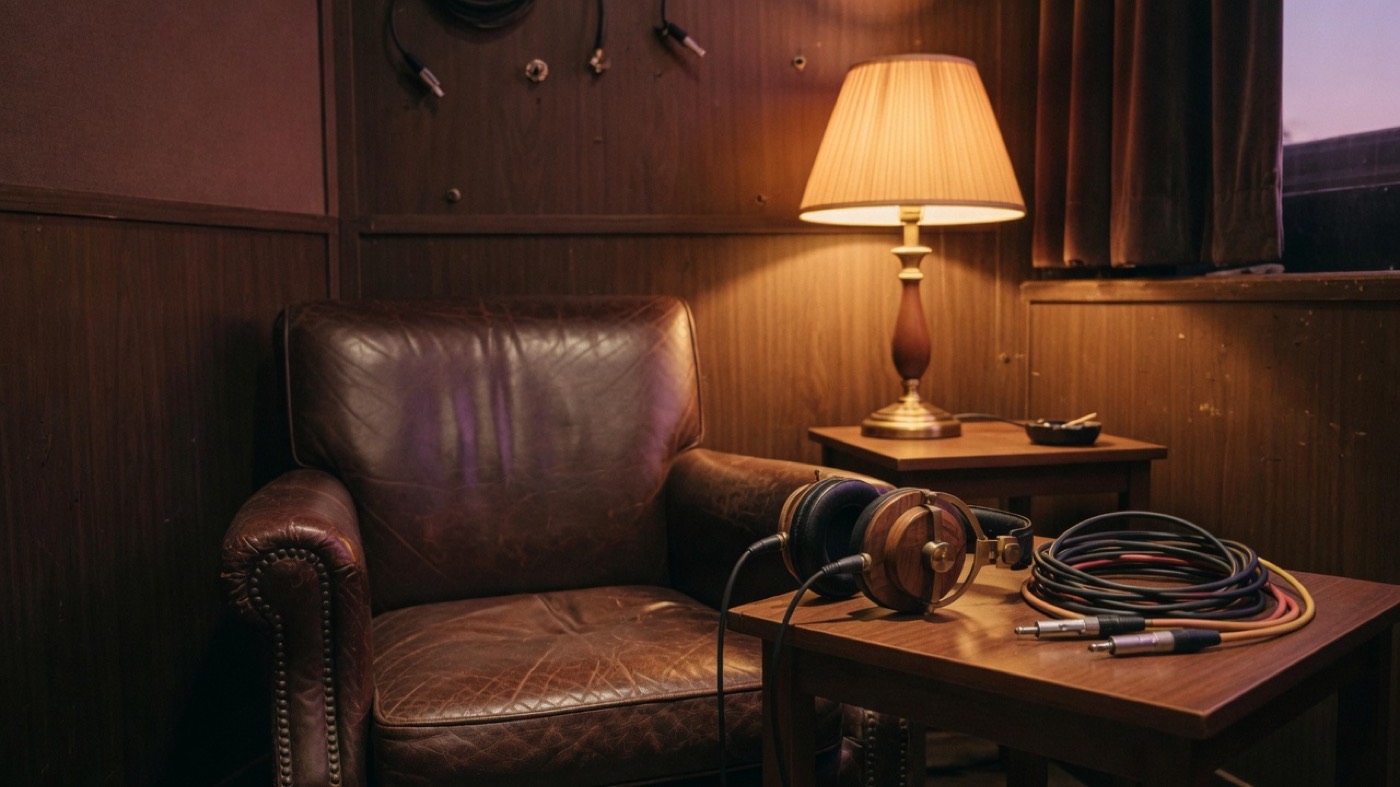
The binaural percept: two isolated carriers, a difference heard as a pulse. Headphones required. Oster 1973.
Some trials report modest state-anxiety shifts in specific settings (Padmanabhan 2005 preoperative; Garcia-Argibay 2019 pooled anxiety).
Size, reliability, EEG correlates, and whether consumer files match trial protocols. López-Caballero & Escera 2017 is a useful null.
Using beats as a stand-in for care, a panic protocol, or a long-horizon change to trait anxiety.
Volume, bands, and overstimulation
If you came for the edge off, high beta is often the wrong neighborhood. Charts run beta up toward 30 Hz. The upper part of that range can co-travel with tightness, the over-caffeinated feeling, the sense that the room got smaller. Stacking espresso, loud volume, and a 25 Hz difference is a dare, not a method. More hertz is not more relief. It is a different street.
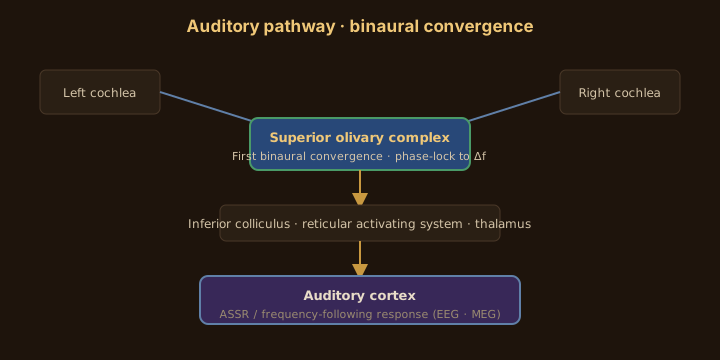
Practical listening on this desk, when the hour is tight:
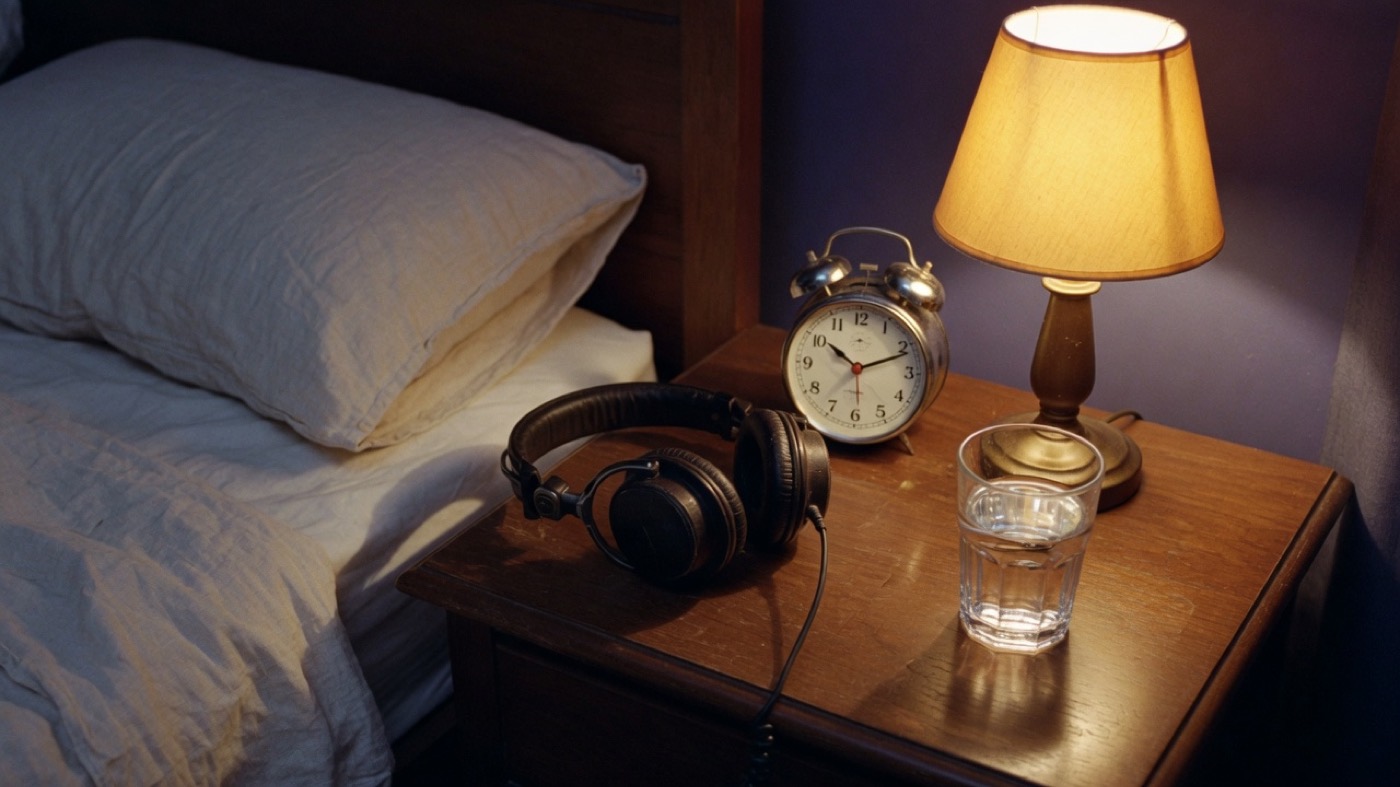
- Stereo headphones. True isolation. See the headphones guide.
- Comfortable volume — below conversation. Louder is not more effect.
- Prefer a downshift arc (higher band toward alpha or theta) rather than a bright beta bed.
- Pair with slow breathing if that is already your habit. Audio is a scaffold, not a spell.
- Stop if distress increases. HALT is a control, not a failure.
The mechanism, if you want the physics before the hour, is how binaural beats work. The definition demo is what are binaural beats.
A designed listening arc, not medicine
Anxiety Unwind is a 40-minute true-stereo program on this machine: a downshift in carriers and bands, written as an evening-shaped arc. I am telling you what it is — a designed listening object — and what it is not. It is not a device. It is not an adjunct to anesthesia. It is not a protocol for panic. If you run it, run it as you would run a quiet album: cups on, a length, a room you can leave.
You can also skip programs and set the Console yourself. Alpha as a design target (8–13 Hz) or theta (4–8 Hz), a carrier that does not bite, a timer. Engineering notes live on methodology. Band names as menus live on brainwave bands.
I will design you an hour. I will not name your life a clinic.
What to do instead of magic
If the hour is merely loud in the head, a short true-stereo sit can be a reasonable experiment: headphones, modest volume, a downshift, ten to twenty minutes, then HALT and stand up. If the hour is a crisis, you already know the next step and it is not this page. If the hour is a long climate of fear, that is a clinical conversation, not a carrier frequency.
Do not drive with a sleep-leaning unwind in the cups. Do not use bone conduction and call it a binaural test. Do not play the pair off a phone speaker and decide the literature is fake. Oster’s split still holds: isolation, or you are listening to something else. For the longer sit-companion essay, see binaural beats for meditation. For the operator procedure, see how to use binaural beats.
I built this console to be honest in the copy and true in the stereo image. Honesty, on anxiety, looks like a small claim held next to a larger duty of care. The claim: some people, in some protocols, report a modest shift in state. The duty: if you need help, you get help. The oscillators will still be here after.
What a downshift actually is
On a console, a downshift is a designed move from a brighter difference toward a slower one — often a low-beta neighborhood toward alpha, then theta — while the carrier may also walk down so the pitch gets easier. Anxiety Unwind is that kind of object: forty minutes, true stereo, a written arc. I am not saying your nervous system will follow the chart. I am saying the audio has a shape, and shape is kinder than a random 40 Hz flex when the hour is already tight.
You can build a smaller version by hand. Ten minutes in low alpha. Then ten in theta. Carrier unchanged if it is already comfortable. Volume below conversation. If the first ten minutes brighten you the wrong way, you do not “push through.” You HALT. Pushing through is how a listening tool becomes a dare.
What I will not put in the cups
I will not put a high-beta bed under a tight chest and call it exposure. I will not put a sleep-leaning delta pair under a commute. I will not put a YouTube “remove anxiety in 8 minutes” caption on this machine. The literature we have is modest, situational, and mixed. Padmanabhan’s wait, Garcia-Argibay’s pooled mean, López-Caballero’s null. That triangle is the adult furniture. Anyone selling a fourth point labeled “guaranteed” is not sitting at this desk.
If you want the sit-companion version of this honesty, read the meditation inquiry. If you want the operator card, read how to use. If you want the band menu, read the atlas. Then put the cups on or don’t. The hour is yours. The console is free to ENGAGE. Care, when you need it, is still care.
What we still do not know
We do not know how well a consumer program matches the files used in a 2005 theatre-wait study. We do not know who is a responder. We do not know how much of a short-term shift is the beat, the ritual, the expectation, or simply sitting still. Trait change over months is not what this literature is built to answer. López-Caballero and Escera (2017) remind us that EEG and arousal do not automatically follow the marketing. Mixed is the honest word, and it will stay the honest word until better, larger, better-controlled work exists.
Questions operators actually ask
Can binaural beats help with anxiety?
Some trials report modest shifts in state anxiety in specific settings. That is a small, mixed literature, not a stand-in for care. Not a treatment. This console is a listening instrument. If you are in crisis, get care, not a frequency.
What is the difference between state and trait anxiety?
State is the weather of the hour. Trait is the climate of months and years. Most binaural-beat studies that mention anxiety are measuring the weather after a short session. They are not rewriting a climate.
Is there a binaural frequency for panic?
No. This desk has no panic protocol. High beta can feel edgy. If distress rises, HALT and get human help. A generator is not an emergency plan.
What is Anxiety Unwind?
A designed 40-minute true-stereo listening arc on this machine — a downshift in bands and carriers. It is a program, not medicine. Headphones, a room you can leave, Halt if it tightens.
Should I use high beta to push through anxiety?
I would not. High beta can feel tight or over-caffeinated. If you came for the edge off, a quieter alpha or theta design target and a modest volume are the more sensible neighborhood.
Do I need headphones?
For a true binaural beat, yes. Speakers mix the pair in air. Isochronic pulses are a different signal and do not require headphones. Do not fail a binaural file on a kitchen cone and call the science fake.
What if a session makes me feel worse?
HALT. Take the cups off. Lower volume next time or skip audio. Feeling worse is information, not a dare to finish the track. If you need care, get care.
Keep reading
Educational listening notes from a working audio engineer. Not medical advice. Not a medical device. Headphones required for a true binaural beat. Methodology · About · Garcia-Argibay 2019