Console · About · Articles · How to use binaural beats
Practice
How to use binaural beats
Headphones. True stereo. A length you will actually finish. Then HALT. That is the whole method.
The honest answer
Stereo headphones on both ears. A comfortable volume. A carrier that does not bite. A beat that matches the hour. A length you will finish. ENGAGE. Stay. HALT. Speakers, one ear, and bone conduction are different experiments. Bluetooth latency is usually fine; mono collapse is not.
The whole method
Headphones. True stereo. A length you will actually finish. ENGAGE. Stay. HALT. That is the procedure. Everything else on this page is commentary from a working engineer who has watched people fail the procedure in the same five ways since 2010: speakers, one ear, bone conduction, heroic volume, and an infinite session they abandon at minute four.
If you will not put cups on both ears, you are not running a binaural test. You are running a speaker test and calling it research.
The definition, if you want it first, is what are binaural beats. The physics is how binaural beats work. The build notes are methodology. This inquiry is the operator card: how to run a session on this console without fooling yourself.
Headphones, or you are listening to something else
A binaural beat needs isolation. Left carrier stays left. Right carrier stays right. The auditory system compares them. Speakers dump both tones into the same air; the difference becomes an acoustic beat in the room, or a smear, and the binaural object is gone. A phone speaker is the same failure with worse bandwidth. One ear is not a comparison. Bone-conduction headbands couple through the skull; they are a different delivery, and I will not call them a binaural test on this desk.
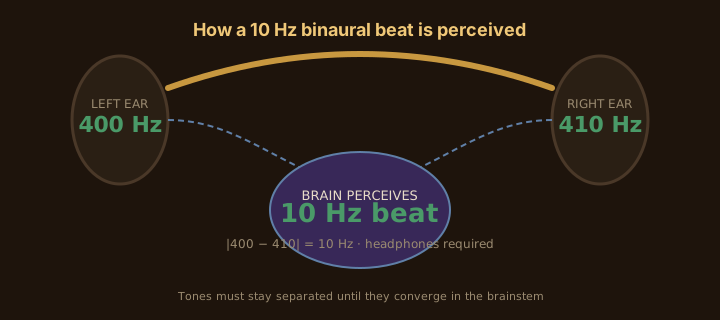
- Use: stereo over-ear or in-ear headphones, both drivers alive, balance centered.
- Do not use as a binaural test: laptop speakers, a phone speaker, a car cabin, one dead bud, a mono Bluetooth mode.
- Bone conduction: a different machine. Interesting, not this protocol.
The longer gear note is the headphones guide. Cheap stereo cups can work. Price is not the variable. Isolation is.
| Setup | Binaural test? | Why |
|---|---|---|
| Stereo over-ear or in-ear, both drivers | Yes | Isolation to each ear |
| Phone / laptop speaker | No | Mixes in air |
| One ear / one dead bud | No | No comparison |
| Bone conduction | No | Different delivery |
| Bluetooth, pan-tested stereo | Usually | Latency is fine; mono collapse is not |
Bluetooth, latency, and the mono trap
Bluetooth latency is usually fine for binaural beats. A 6 Hz pulse is not a snare you are trying to click-sync to a film. Tens of milliseconds of delay do not ruin the difference between 200 and 206 Hz. What ruins the difference is a codec, a headset, a car adapter, or an accessibility stack that sums left into right without a visible warning.
If you insist on wireless, pan-test every time you change devices: a file hard-left should go silent in the right cup. Wired remains the boring default on this bench. The dedicated note is Bluetooth and binaural.
Volume and carrier comfort
Louder is not more effect. It is more risk to the ear and more tension in the jaw. Set volume below conversation. You should be able to hear a person in the room if they say your name. The carrier — the audible pitch — should not bite, whistle, or feel like a dentist. If it does, change it. On this console, many people live between roughly 100 and 250 Hz for carriers. That is preference, not law. Comfort is the engineering spec.
The beat frequency is the other number: the difference. That is the design target people map to delta, theta, alpha, beta, gamma. Do not confuse the two. Carrier is pitch. Beat is pulse. The calculator that keeps them straight is the binaural beat calculator. The atlas is binaural beat frequencies and brainwave bands.
Pick a length, then stay
Open-ended sessions are how people fidget with knobs and decide the method failed. Pick 12, 20, 30, or 45 minutes — a length you will finish — and leave the console alone. ENGAGE. Stay. If you must journal, journal after HALT, not during. A line or two: date, beat, carrier, length, whether the hour felt spacious, tight, sleepy, or ordinary.
- ENGAGE — start the true-stereo pair.
- Stay — the unfashionable part. Breath, body, the pulse. No mid-sit shopping for a better hertz.
- HALT — stop. Take the cups off. Stand up. The beat does not need to run until morning to “count.”
Journaling is optional. It is a memory aid, not a sacrament. If you hate notes, skip them. If you like notes, keep them short enough that you will actually write them.
Where not to listen
Do not drive with a sleep program in the cups. Do not operate machinery on a delta-leaning unwind. A meditation sit is a sit; a focus bed is a desk job; a sleep design is for a bed. Match the hour to the room. I will not romanticize “I listened on the highway and woke up in my driveway.” That is not a testimonial. That is a warning.
Side-sleepers: over-ear cups can torque a jaw and an ear. In-ears can lodge or sit at a volume you would not choose awake. Prefer a timer, a lower level, and permission to take the cups off when the eyelids win. Falling asleep in hardware is a comfort question, not a flex.
Children, photosensitivity to pulsed light (this is audio, but stacked “entrainment” videos are a different object), and anyone who feels wrong mid-session: stop. The safety inquiry is are binaural beats safe. The short version is: they are audio. Handle them like audio — modest level, stop if it feels wrong.
A first session, start to halt
Put stereo headphones on. Open the Console. Set a carrier that is easy in the cups. Set a beat that matches the hour — theta or low alpha for a sit, low beta for a desk, not high beta if you already feel tight. Set a length. Volume down. ENGAGE. Do not chase a sensation. When the length ends, HALT. Drink water like a person who sat in a chair. That is a complete use of the instrument.
If you want a sit-shaped essay, read binaural beats for meditation. If the hour is tight in the chest, read binaural beats for anxiety first — especially the part that says this is not a panic protocol. If you want the band menu, use brainwave bands.
Headphones and isolation are required for a true binaural beat. Speakers and mono collapse the object. Oster 1973.
A timed session at comfortable volume is a sane way to use the tool. Carrier comfort matters as much as the beat number.
Whether any given band will match the hour for you. Individual differences are large. Try, journal if you like, keep what lets you stay.
Running sleep designs in a car, heroic volume as “more entrainment,” one-ear tests, and the idea that a session must last all night to count.
Oster, G. (1973). Auditory beats in the brain. Scientific American, 229(4), 94–102. Outcome literature (modest, mixed): Garcia-Argibay, Santed & Reales (2019), Psychological Research, DOI 10.1007/s00426-018-1066-8 — plain-language map. EEG caution: López-Caballero & Escera (2017).
You do not need a better origin story than that. Cups on. A length. ENGAGE. Stay. HALT. The console is free to start. The discipline is not included.
A pan test you can do in thirty seconds
Before you trust a new headset, play a file or a console pair panned fully left. The right cup should go quiet. Fully right: the left cup should go quiet. If both cups keep talking, something in the chain is summing. That something may be a Bluetooth codec, a “mono for accessibility” toggle, a car adapter, or a broken driver. Until you fix it, you are not running a binaural session. You are running a mono session with extra hardware.
I still prefer a cable. Not because I am romantic about copper. Because a cable fails loud: it either works or it doesn’t. Wireless fails polite: it keeps making sound while quietly folding the image. Polite failures waste evenings.
Carrier examples, not laws
If 200 Hz feels like a whistle, drop toward 140. If 100 Hz feels muddy on small in-ears, climb toward 180. The beat can stay at 6 or 10 the whole time. That is the point of two knobs. People who only own one number — “I do 432” or “I do 40” — are often mixing pitch slogans with difference rates. The calculator exists so you can see left and right as arithmetic instead of folklore.
A first week I actually recommend: same carrier, three beats, three days each. 6 Hz sit. 10 Hz eyes-soft. 16 Hz desk. Length fixed at twenty minutes. Notes optional. At the end you will know more about your cups and your hours than a hundred tabs will teach you. Then you can ignore me and keep the one that let you stay.
ENGAGE and HALT are not poetry
On this machine ENGAGE starts the true-stereo pair. HALT stops it. There is no secret third mode where the oscillators keep working after you leave the room. If you walk away with the pair still running into empty cups on a table, you are wasting electricity and you are not meditating. If you fall asleep, a timer is kinder than an all-night loop at a volume you set while awake. Side-sleepers: take the hardware off. The beat does not need to finish the program to have been a session.
Common failures I still see: one dead bud, a phone on speaker “just to try,” bone-conduction marketed as binaural, sleep designs in a car, volume as ambition, and mid-sit shopping for a better hertz. The procedure above is how you stop adding those. It will not make the hour mystical. It will make the hour a fair test of the instrument. If you want a sit-shaped target after the procedure is in your hands, theta or low alpha is the usual neighborhood. If the hour is already tight, do not brighten the pair as a dare. The anxiety inquiry exists so this operator card can stay an operator card.
What we still do not know
We do not know your best carrier, your best beat, or your best length. Those are operator variables. We do not know whether a wireless codec you have not pan-tested is summing the image. We do not know how much of a “good session” is the pair versus the ritual of sitting still. The procedure above is how you stop adding avoidable errors. It is not a guarantee the hour will feel like a caption.
Questions operators actually ask
Do I have to use headphones?
For a true binaural beat, yes. Speakers mix the tones in air. One ear cannot compare. Bone conduction is a different delivery. Isochronic tones are a different signal and do not require headphones.
Can I use Bluetooth headphones?
Often yes, if the stream stays stereo. Latency is usually fine for a slow beat; this is not a click-sync problem. The failure mode is mono collapse. Pan-test: hard-left should silence the right cup. Wired is the boring default.
How loud should binaural beats be?
Below conversation. You should still hear a person say your name. Louder is not more effect. If the carrier bites, turn it down or change the carrier, not the beat.
How long should a session be?
A length you will finish. Twelve to thirty minutes is a sane first window. Open-ended sessions invite knob-fidgeting. The beat does not need to run until morning to count.
Can I listen while driving?
Do not drive with a sleep program in the cups. Match the design to the room. A focus bed at a desk is one object. A delta-leaning unwind is another. Machinery and sleep designs do not share a cabin.
I sleep on my side. Are headphones safe?
Over-ear cups can torque a jaw. In-ears can lodge. Use a timer, a lower level, and permission to take them off when you would have turned off a lamp. Comfort beats dogma.
Where do I press start?
Open the Console, set carrier and beat, set a length, volume down, ENGAGE. Stay. HALT. That is a complete session.
Should I keep a journal?
Optional. A line after HALT is enough if you like data: beat, carrier, length, how the hour felt. Do not grade yourself. Skip notes if they become another performance.
Keep reading
Educational listening notes from a working audio engineer. Not medical advice. Not a medical device. Headphones required for a true binaural beat. Methodology · About · Garcia-Argibay 2019