Console · About · Articles · Binaural beats for meditation
Meditation
Binaural beats for meditation
Theta and alpha designs can sit under a sit. They do not replace breath, posture, or time on the cushion.
The honest answer
A binaural pair can support a meditation sit the way a quiet room supports one: as a field, not as a shortcut. Theta (4–8 Hz) and alpha (8–13 Hz) are the design targets I reach for. They are not enlightenment frequencies. Headphones required. The sit is still yours.
A support, not a shortcut
I have mixed meditation sits with tones since the early 2010s, first on analog benches and later on this browser console. The honest pattern is boring: a binaural pair can make a sit easier to enter, and it cannot do the sit for you. Breath still has to be breath. Posture still has to be posture. Time on the cushion still has to be time. If a thumbnail promised enlightenment at 6.3 Hz, it was selling a SKU, not a practice.
On this desk a meditation design is a field you sit inside. Theta (4–8 Hz) and alpha (8–13 Hz) are the neighborhoods I reach for most often. They are design targets borrowed from EEG charts, not a promise that your cortex will clock to the difference. The beat is the difference between two carriers, one per ear. The sit is still yours.
The tone is a companion for the hour. It is not a ladder out of being a person.
If you want the operator page for sitting with programs, start at the meditation guide and the interactive room at /for/meditation/. This inquiry is the longer magazine answer: what the signal is, which numbers I actually use, how guided and unguided sits differ, and why expectation wrecks more sessions than the oscillators do.
What the signal actually is
Gerald Oster’s 1973 Scientific American piece is still the clean public-science split. Two close pure tones, isolated left and right, produce a slow pulse that is not a third speaker in the room. The comparison happens in the auditory pathway. Speakers mix the pair in air and the binaural object collapses. That is why this console insists on stereo headphones. Not branding. Method.
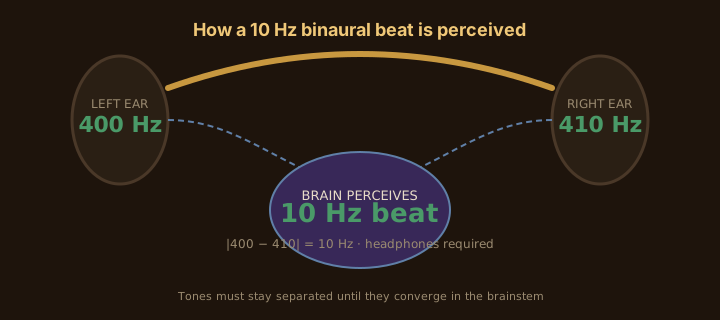
Three numbers end most confusion, and they are the same three I use on a workbench:
- Carrier — the audible pitch in one ear, typically tens to a few hundred hertz. Comfort lives here.
- Beat — the difference between ears. This is the pulse people map to band names.
- Band label — theta, alpha, and the rest. A chart borrowed from EEG. A listening target, not a lab printout of your skull.
The mechanism page is how binaural beats work. The plain definition with a demo is what are binaural beats. Engineering choices for this machine live on methodology. If you only remember one sentence: headphones required, true stereo, no third tone in the air.
Oster, G. (1973). Auditory beats in the brain. Scientific American, 229(4), 94–102.
Theta 4–8 and alpha 8–13 as design targets
I do not sell enlightenment frequencies. I pick a neighborhood that matches the hour, then I sit. For an unguided sit I usually land in theta, often around 6 Hz, with a carrier that is easy in the cups — 140 to 180 Hz is a common comfort band on this console. For a slightly brighter, eyes-soft sit I move into low alpha, often 8–10 Hz. The borders are conventions, not fences. Charts disagree by a hertz or two and nobody’s cortex files a complaint.
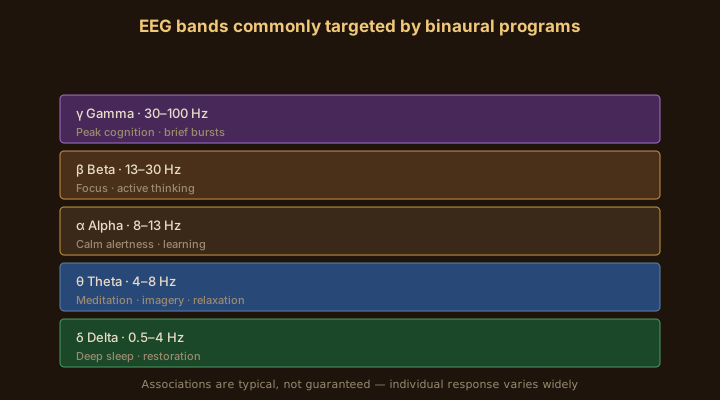
The interactive map is brainwave bands. The atlas inquiry is binaural beat frequencies. Use those pages as menus. Do not use them as prophecy. More hertz is not deeper meditation. High beta can feel edgy. Gamma-as-flex is gym culture that wandered into a zafu. If you came to sit, you probably want a slower difference, a quieter carrier, and a length you will actually finish.
| Design target | Beat range | How I use it on a sit |
|---|---|---|
| Theta | 4–8 Hz | Unguided sit, inward, low light |
| Low alpha | 8–10 Hz | Eyes-soft, still present to the room |
| Alpha | 8–13 Hz | Open awareness, not a nap |
| Delta | 0.5–4 Hz | Rest-adjacent; easy to drift; not a meditation badge |
| Beta / gamma | 13 Hz and up | Usually the wrong room for a sit |
You can hear the pair live on the Console. Set carrier for comfort, beat for the hour, volume below conversation. Then leave the knobs alone. Fidgeting with hertz mid-sit is just another thought with a brass cap.
Guided versus unguided
A guide is a voice. A tone is a field. They are not the same practice, and stacking both with a podcast is a party, not a sit. Unguided with a quiet binaural pair is the default on this desk: breath, body, the difference in the cups. Guided work — a teacher in the room, or a GUIDE layer if you are a Member — is a different object. Language occupies the hour. That can be useful. It is also extra furniture.
Pick one kind of support. Silence is a valid kind. Tone-only is a valid kind. One voice plus a quiet pair can work if the voice is sparse. Three layers of instruction plus a busy gamma block is how people decide “meditation with beats doesn’t work.” It was never given a chance to be small.
- Unguided: choose theta or low alpha, a length, headphones, ENGAGE, stay.
- Guided: let the voice lead; keep the beat simple and quieter than the talker.
- Neither: sit without audio. This console will not be offended.
The purpose page at binaural beats for meditation is built as a true-stereo demo in that theta/alpha window. Use it as a room, not as a diploma.
Expectation is extra noise
If you demand theta visions because a caption promised them, you are bargaining. Bargaining is extra noise. Placebo and expectation are real in listening studies. That does not mean you must fake belief. It means dropping the sales pitch is part of the method. ENGAGE without a plot. Notice breath and sound. If something unusual happens, write it later. If nothing happens, that was also a sit.
Expecting fireworks is how sits feel like broken products. The beat is a field. The mind will still mind.
I journal some sessions and skip others. A line or two after HALT is enough: length, beat, carrier, whether the hour felt spacious or tight. Do not grade yourself. The oscillators do not keep a high-score table. Neither should you.
A session on this console
The longer operator procedure lives in how to use binaural beats. For a meditation sit the short version is this:
- Stereo headphones. Not a phone speaker. Not one ear. Not bone-conduction as a binaural test.
- Comfortable volume. Louder is not more sit.
- A length you will finish — 12, 20, 30 minutes. Open-ended is how people fidget.
- Carrier that does not bite. Beat in theta or alpha as a design target.
- ENGAGE. Stay. HALT. Take the cups off. Stand up like a person who sat.
Bluetooth latency is usually fine for a slow beat; this is not a click-sync problem. It fails when a codec or a headset sums the image to mono. Wired remains the boring default. Details are in the headphones guide.
Do not drive with a sleep-leaning program in the cups. A meditation sit is a sit. If the design is drifting toward delta and the eyelids are winning, you are not in traffic. Side-sleepers: over-ear cups can torque a jaw; in-ears can lodge. Comfort beats dogma. Halt when you would have turned off a lamp.
What the ledger actually says
The auditory illusion is established. Outcome studies are mixed and modest. Garcia-Argibay, Santed, and Reales (2019) pooled 22 studies and 35 effect sizes across cognition, anxiety, and pain perception and reported a small-to-moderate average (Hedges’ g ≈ 0.45). That paper is not a meditation RCT, and I will not pretend it is. It is the honest modern ledger for “does anything happen besides the pulse.” López-Caballero and Escera (2017) reported no clear EEG-power or emotional-arousal enhancement under their parameters. Keep the null next to the mean. Settled fields do not still publish careful failures.
The binaural percept itself: two isolated carriers, a difference heard as a pulse, headphones required. Oster 1973 remains the public explanation.
Using a quiet theta or alpha pair as a sit companion is a reasonable design. Many operators, myself included, find the field makes it easier to stay.
Whether the beat changes EEG bands or deepens “meditation outcomes” in a reliable, protocol-proof way. López-Caballero & Escera 2017 is a useful null.
Enlightenment frequencies, guaranteed cortical lock, and any claim that a hertz replaces breath, a teacher, or years of showing up.
Garcia-Argibay, M., Santed, M. A., & Reales, J. M. (2019). Efficacy of binaural auditory beats in cognition, anxiety, and pain perception: a meta-analysis. Psychological Research, 83(2), 357–372. DOI 10.1007/s00426-018-1066-8. Plain-language map: Garcia-Argibay 2019.
López-Caballero, F., & Escera, C. (2017). Binaural beat: a failure to enhance EEG power and emotional arousal. Frontiers in Human Neuroscience, 11, 557.
What this desk will not claim
I will not tell you a frequency awakens you. I will not tell you theta is the gate and alpha is the lobby. I will not tell you this console is a monastery. It is a true-stereo instrument. You bring the sit. If the hour wants silence instead, skip the pair. That is also practice.
Open the Console, put the cups on, pick a length, and sit inside a number you chose on purpose. Then HALT. The rest of the path is older than oscillators, and it does not need a product name.
A week, not a thumbnail
If you want a method instead of a mood, run one target for a week. Six hertz, same carrier, twenty minutes, same chair. Notes optional. At the end you will know whether that pair is a companion or a distraction. Shopping a new integer every night is how sits become product tests. Product tests are extra noise. The metronome on the hero image is there for a reason: a sit has a pulse you keep, not a catalog you refresh.
I still change numbers. I change them between hours, not inside them. Morning desk is not evening sit. Evening sit is not a sleep-leaning drift unless I meant to lie down. The atlas is a menu. The session is one plate. Headphones, a length, ENGAGE, stay, HALT. Then you are a person who sat, which is the whole point of asking a console for help with meditation in the first place.
What we still do not know
We do not know whether a consumer theta pair reliably shifts your EEG into the band on the chart. We do not know who benefits, for how long, or whether the benefit is the beat, the ritual, the expectation, or the simple fact of sitting still with headphones on. López-Caballero and Escera’s 2017 null is as much a part of the furniture as any pooled mean. Individual differences are large. If a sit feels worse with audio, take the cups off. Silence is an instrument.
Questions operators actually ask
What frequency should I use to meditate?
There is no enlightenment frequency. On this desk, theta (about 4–8 Hz) and low alpha (about 8–10 Hz) are the usual design targets for a sit. Pick a number in that window, a comfortable carrier, and a length you will finish. Charts are menus, not prophecy.
Do I need headphones for meditation binaural beats?
Yes, if you want a true binaural beat. The pair has to stay isolated until your auditory system compares the ears. Speakers, mono Bluetooth, and one-ear listening collapse the object. Isochronic pulses are a different signal and do not require headphones.
Can binaural beats replace a meditation practice?
No. They can sit under a sit. Breath, posture, and time on the cushion still have to happen. If the hour wants silence, skip the pair. That is also practice.
Should I use a guided track or just the tones?
Pick one kind of support. Unguided with a quiet pair is the default here. A sparse guide plus a simple beat can work. Stacking a podcast, a mantra app, and a busy gamma block is a party, not a sit.
Why don’t I feel anything?
A lot of sits feel like sitting. Expectation of fireworks is extra noise. Notice breath and sound. If the carrier is harsh, change it. If the beat feels edgy, step down in hertz or HALT. Nothing happening was still a sit.
Is theta better than alpha for meditation?
Not as a law. Theta is a common inward target; low alpha is a common eyes-soft target. Borders are conventions. Try both across a week and keep the one that lets you stay. More Hz is not deeper.
Where do I start on Binaural Beat Machine?
Headphones on. Open the Console, set a theta or low-alpha beat with a comfortable carrier, pick a length, ENGAGE, stay, HALT. The meditation purpose page and the meditation guide are the shorter rooms if you want a demo first.
Keep reading
Educational listening notes from a working audio engineer. Not medical advice. Not a medical device. Headphones required for a true binaural beat. Methodology · About · Garcia-Argibay 2019