Console · About · Articles · Binaural beats for studying
Study
Binaural beats for studying
Use them as a timed study bed. They will not encode a textbook. Frequency choice is a design, not a grade.
The honest answer
A study pair is an attention bed, not a download. Headphones, a timer, one task. Beta and alpha are design targets, not grades. The literature is modest and direction-sensitive. Sleep still wins.
An attention bed, not a download
I have mixed study audio since 2010 the same way I mix a vocal: furniture first, hero second. A binaural pair for studying is furniture. It is a bed under a task. It will not encode a chapter. It will not sit the exam. If the room is noisy, if the phone is face-up, if you have not written the next twenty-five minutes as a single outcome, no oscillator will save the hour.
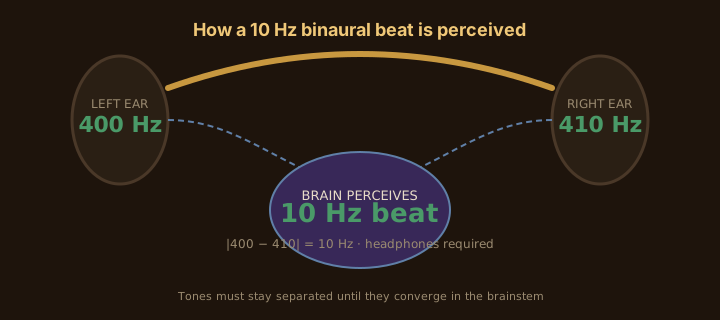
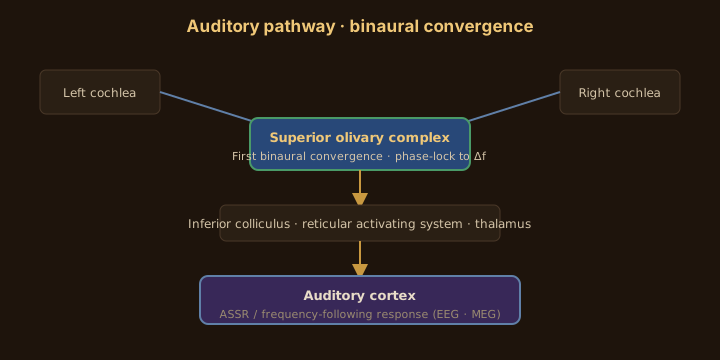
A binaural beat is a perception your auditory system builds when each ear receives a slightly different pure tone. Headphones required. Speakers fold the two carriers into one air, and the intended difference never arrives. That is the whole instrument. The rest is operator craft. See what binaural beats are and how they work if you want the mechanism before the desk.
Use them as a timed study bed. They will not encode a textbook.
On this console, ENGAGE is free. You put on stereo headphones, you pick a beat, you work. Membership exists for GUIDE, drums, extra programs, and WAV export. Studying does not require any of that. A pair of carriers and a timer will do.
Beta versus alpha, depending on the task
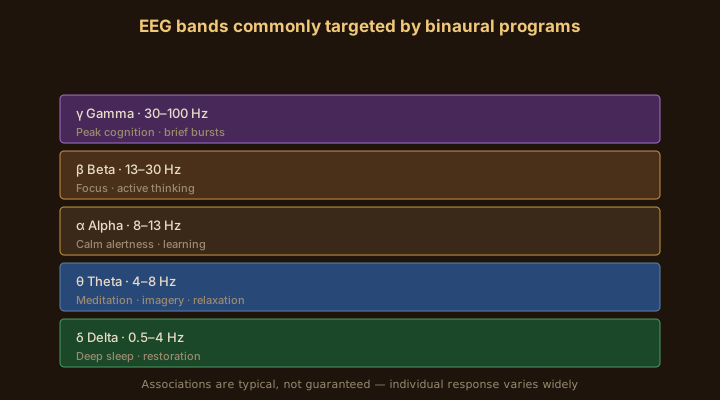
Band names are borrowed EEG labels. They name a listening target. They do not promise your lab EEG will follow. I still use them because they are the language operators already have, and because the cognitive literature is not indifferent to direction. Garcia-Argibay and colleagues showed that frequency direction matters for memory: beta-range designs and theta-range designs are not interchangeable furniture.
For reading notes, outlining, and language absorb, I usually park in high alpha / low beta — roughly 10 to 14 Hz as a design target. The field should feel engaged without being frantic. For active problem-solving, proofs, debugging, or a tight problem set, I will step into mid-beta, around 14 to 18 Hz, and I will keep the block shorter if the field feels tight. Deep delta is a rest design. It is a poor study bed. Theta is a meditation and imagery neighbor, not a default encoding bed. If a caption told you “any binaural beat helps learning,” that caption is false.
| Task | Design target | Operator note |
|---|---|---|
| Reading / notes | High alpha / low beta (~10–14 Hz) | Default study bed |
| Problem-solving | Mid-beta (~14–18 Hz) | May feel intense; shorter blocks |
| Start / stop bookends | Gentle alpha (~9–11 Hz) | Avoid a hard crash at the break |
| Deep rest | Delta-range | Not a study bed |
The interactive studying page on this site defaults near 12 Hz with reading and problem-solving presets. That is a starting chair, not a doctrine. If 16 Hz makes you jaw-clench, step down. If 10 Hz makes you drift, step up. The honest move is one clear task and a pair you can almost ignore. Practical numbers live on best frequencies for studying and the interactive studying session.
Carriers matter more than wellness copy admits. Oster already noted that the binaural percept is stronger at modest carriers and weakens as the tones climb. I like carriers in the low hundreds of hertz — listenable, not piercing — so the hour can finish. Extreme carriers are a dare, not a grade. If the tone hurts, change pitch or Halt. Comfort is the range.
Timed, pomodoro-style, with a real ending
Pomodoro is a timer culture. Binaural is a stereo pair. They fit because both respect an ending. Twenty-five on, five off is a classic. Fifty on, ten off also works if the task is deep. The beat belongs in the on. The off should be quieter — eyes, water, a window, no new hertz. If you keep the audio running through breaks, you never change state. The technique’s point was the cut.
- Write one outcome for the next 25 to 50 minutes. One. Not a week.
- Stereo headphones. Volume you could almost ignore. See the headphones guide.
- Pick a target. ENGAGE. Do not retune mid-block unless the field feels wrong.
- Work until the timer ends. Halt. Break without audio.
- Optional second block on purpose, not on autopilot.
The Console timer is enough. You do not need a third app to bless it. Open the Console, set length, ENGAGE. If you want the math before you listen, the beat calculator will show left and right from carrier plus difference. That tool is a calculator. The homepage Console is the instrument.
I will say this as an engineer who has watched people sit in a loop: a forever session is not more scholarly. Fatigue is load. Load is not a gift to encoding. Two honest tomatoes beat a three-hour drone you stopped hearing at minute twelve.
What the evidence actually says
Gerald Oster’s 1973 Scientific American piece is still the public-science split: a binaural beat is a central percept, not a third tone in the room. That part is established. Whether a consumer study pair changes memory or attention is a different, more modest literature.
Garcia-Argibay, Santed, and Reales (2019) pooled experimental binaural-beat work across cognition, anxiety, and pain. Twenty-two studies. Thirty-five effect sizes. A pooled Hedge’s g around 0.45 — a moderate mean with the usual meta-analytic bruises: small samples, mixed controls, protocol chaos, publication bias risk. DOI 10.1007/s00426-018-1066-8. That is not a scholarship steroid. It is a reason to take the furniture seriously and the marketing less so.
On memory specifically, frequency direction matters. In related work from the same group, beta-range binaural beats improved long-term memory performance relative to white noise in their paradigm, whereas theta-range beats impaired performance relative to that control. “Any beat helps studying” is therefore not a finding. It is a slogan. If you are encoding, a sleepy theta bed is not a clever hack. It is the wrong chair.
EEG following is mixed. Jirakittayakorn and Wongsawat reported band-related EEG features for specific beat rates in lab conditions. López-Caballero and Escera (2017) reported no clear EEG-power or emotional-arousal enhancement under their binaural-beat parameters. Both papers can sit on the same shelf. A null in one protocol does not erase the percept Oster described. A positive EEG paper does not mean your Tuesday notes will follow. Parameters, duration, and task matter. So does the file-drawer.
Oster, G. (1973). Auditory beats in the brain. Scientific American, 229(4), 94–102. Garcia-Argibay, M., Santed, M. A., & Reales, J. M. (2019). Efficacy of binaural auditory beats in cognition, anxiety, and pain perception: a meta-analysis. Psychological Research, 83(2), 357–372. DOI 10.1007/s00426-018-1066-8. López-Caballero, F., & Escera, C. (2017). Binaural beat: a failure to enhance EEG power and emotional arousal. Frontiers in Human Neuroscience.
The binaural percept is real with isolated stereo carriers. Headphones required. Speakers fail.
Modest, heterogeneous effects in pooled cognition work. Frequency direction can matter for memory tasks.
EEG following and everyday study grades. Lab protocols are not your kitchen table.
Downloading a textbook. Overnight genius. A magic hertz that replaces sleep, retrieval, and a clear morning.
Exam day is not a debut
The night before matters more than a 20 Hz caption. Cramming inside a loud beat at 2 a.m. is two mistakes sharing headphones. If you have not practiced studying with the same audio, do not debut it in the hall. Novelty is load. Load is not a gift on test day.
Practice the pair during ordinary study weeks. Then, if it is already familiar, you may sit with it while you review. You may also sit in silence. Silence is a legal instrument. I wrote a short honest door for this: exam focus, without the steroid story. Exams are sleep, retrieval, and a clear morning. A beta pair is optional furniture.
Not a classroom drug. This console is audio. It is not a medical device. It does not replace sleep, tutoring, or care. If you live with ADHD or another condition that needs a clinician, keep the clinician. A beat is not a substitute appointment.
How I would run a study block on this console
Headphones on. True stereo. Confirm left and right if the pulse feels absent — mono fold-down is a more common failure than “the frequency is wrong.” Volume you could hold a conversation over. Carrier in a listenable range. Beat matched to the task, not to a thumbnail.
ENGAGE at the start of the tomato. Work. Halt at the break. If the field feels tight, drop toward alpha. If you are drifting, a modest step into low beta is more honest than caffeine plus a 40 Hz YouTube mix. Forty hertz is a different inquiry. Studying is usually not a gamma stunt.
Keep a one-line journal if you care about n=1: date, task, beat, minutes, whether the hour actually finished. Two weeks of that beats a forum argument. Methodology for how this machine generates the pair is on methodology. The physics do not change because you have a midterm.
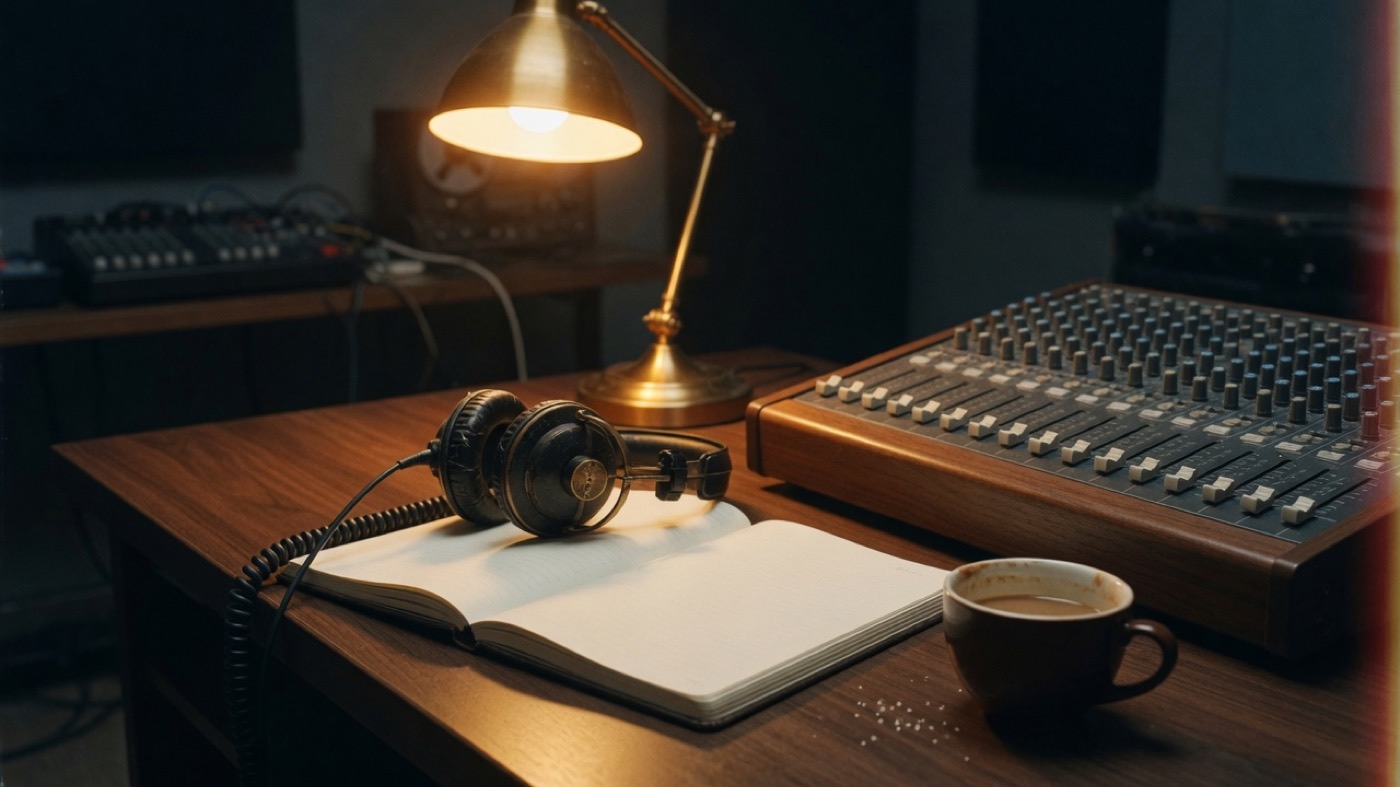
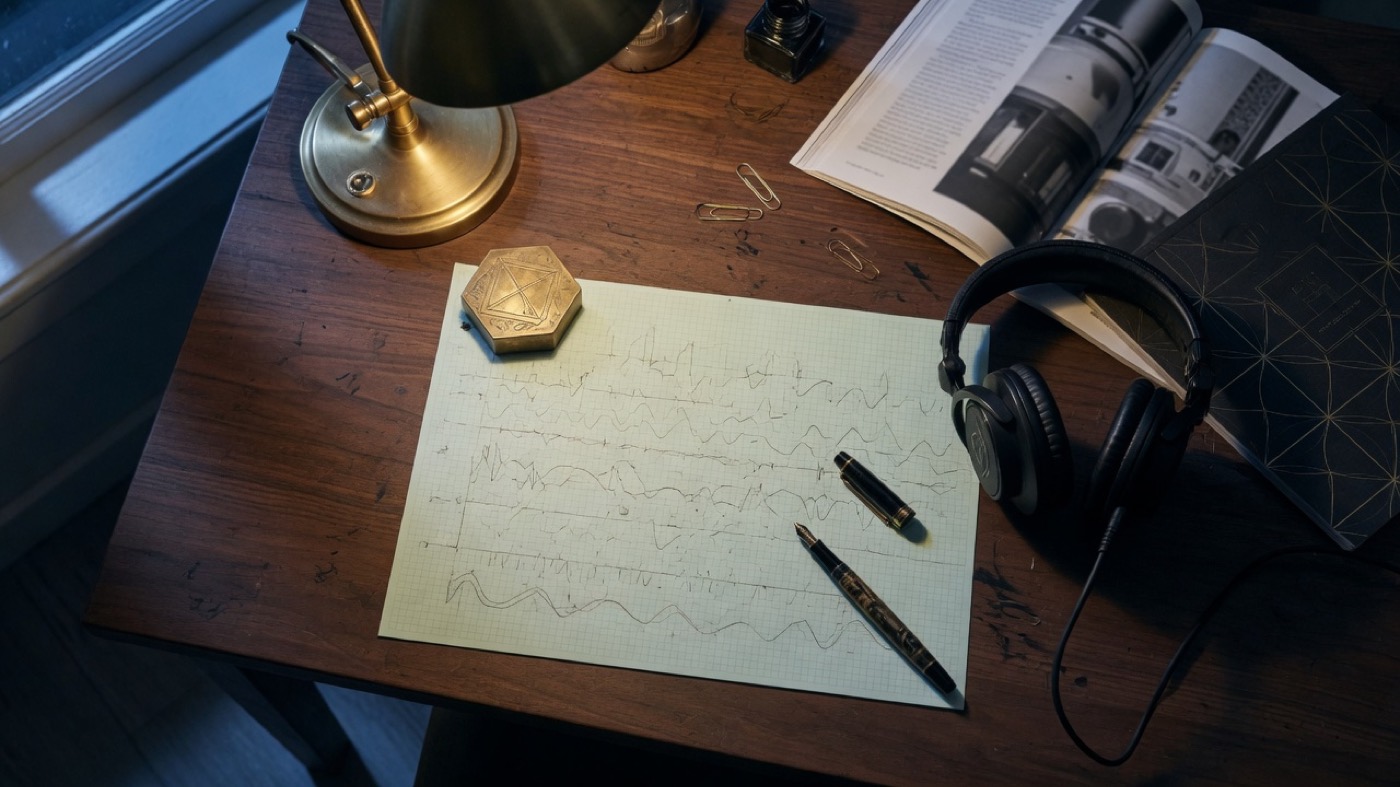
I will not tell you this will raise a GPA. I will tell you a timed, quiet, true-stereo pair is a legitimate way to mark a study block — the way a lamp marks a desk. If the lamp is too bright, dim it. If the pair is wrong, Halt. The honest operator still has to read the page. If silence is the better instrument tonight, skip the beat. That is not a failure of the method. That is the method knowing when to stand down.
What we still do not know
We still do not know which everyday study tasks, if any, will show reliable benefits outside the lab, or how much of a good hour is simply ritual, quiet, and expectation. Individual fit is real and under-measured. I would rather you keep a two-week log than trust a caption.
Questions operators actually ask
What frequency should I use to study?
There is no magic study hertz. High alpha to low beta, about 10 to 14 Hz, is a sane default for reading. Mid-beta, about 14 to 18 Hz, is a design for active problem-solving and may feel intense. Frequency direction matters in memory work, so theta is not a clever encoding hack.
Will binaural beats help me memorize a textbook?
No. They will not encode a chapter. Use them as furniture under a timed block. Retrieval, sleep, and a clear morning still do the academic work.
Do I need headphones?
Yes, for a true binaural beat. Each ear needs its own carrier. Speakers, mono Bluetooth, or one-ear listening collapse the difference.
Should I use them during an exam?
Only if the pair is already familiar from ordinary study weeks. Novelty is load. Many people do better in silence on test day. Do not debut a new beat in the hall.
How long should a study session be?
Long enough to finish one outcome and short enough that you will actually Halt. Twenty-five to fifty minutes on, then a quiet break without audio, is a working pattern.
Is this a treatment for ADHD or test anxiety?
No. This is consumer audio, not a medical device. If you need care, get care. A beat is optional furniture, not a substitute appointment.
Where do I actually listen?
ENGAGE on the Console is free. The studying page has interactive presets. The calculator shows left and right math but is a tool, not the homepage instrument.
Keep reading
Educational listening notes from a working audio engineer. Not medical advice. Not a medical device. Headphones required for a true binaural beat. Methodology · About · Garcia-Argibay 2019