Console · About · Articles · Binaural vs isochronic vs monaural
Comparison
Binaural vs isochronic vs monaural
One is a brain-compared difference. One is a pulsed amplitude. One is a physical mix. They are not interchangeable.
The honest answer
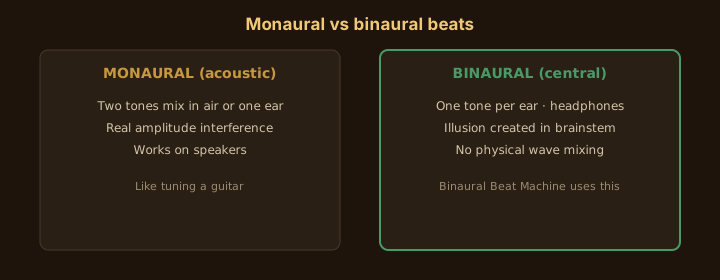
Binaural is a brain-compared difference and needs stereo headphones. Isochronic is a pulsed amplitude and does not require headphones. Monaural is a physical mix. They are three signals. Their papers are not interchangeable. This console is binaural. I will not crown a winner.
Three different signals
People shop “beats” as if the word were one machine. It is at least three. A binaural beat is a brain-compared difference: two steady carriers, hard-panned, isolated until the auditory pathway does the comparison. An isochronic tone is a pulsed amplitude in one stream — on, off, on, off at a chosen rate. A monaural beat is a physical mix: two close tones already combined, so the loudness wobble exists in the air or in the file before it reaches you. Same family name. Different plumbing.
I will not crown a winner. I will tell you which pipes you are holding.
Oster (1973) is still the public-science split between dichotic (binaural) and already-mixed. Acoustic beating is older table physics: two tuning forks, one microphone, a wobble you can record in the room. If you want that version, you do not need this console. If you want the in-head version, you need isolation. Details: acoustic beats vs binaural beats, binaural vs monaural, isochronic vs binaural.
Oster, G. (1973). Auditory beats in the brain. Scientific American, 229(4), 94–102.
A table, not a ranking
| Binaural | Isochronic | Monaural | |
|---|---|---|---|
| What it is | Two steady carriers, one per ear; pulse is perceived | One stream, amplitude pulsed at a rate | Two tones mixed; pulse is physical |
| Headphones | Required | Not required | Not required (one ear can suffice) |
| Speakers | Collapses the object | Can work | Can work |
| What fails it | Mono mix, one ear, bone-conduction-as-test | A pulse so shallow you cannot hear the rate | Summing to a single tone; too-wide spacing |
| This console | Yes — true stereo | A different machine | A different machine |
Read the headphones row twice. It is the row catalogs love to blur. Isochronic does not require headphones. Monaural is a physical mix; one transducer can carry it. Binaural requires stereo isolation. If a file “works on speakers,” it was never asking you for a binaural test. If a file needs headphones, do not fail it on a kitchen cone and call the science fake.
When you might choose each
Choose binaural when you want the dichotic object Oster described, you have stereo cups, and you are willing to keep the chain stereo to the eardrums. That is this desk. Choose isochronic when you want a pulse you can hear on a speaker — a clicky or pumping envelope at a chosen rate — and you do not have headphones, or you do not want a left/right split. Choose monaural when you want the acoustic-beat family: two close frequencies mixed so the loudness wobbles in the waveform itself.
- Binaural — private, cups on, no third tone in the room, sensitive to mono collapse.
- Isochronic — obvious pulse, speaker-tolerant, can feel more aggressive at the same nominal rate.
- Monaural — physical beat, speaker-tolerant, closer to tuning-fork physics than to brainstem comparison.
None of those sentences is a quality ranking. An aggressive isochronic pulse can be the wrong texture for a sit even if it “works on speakers.” A gentle binaural pair can be the wrong object if you are walking a kitchen and refused the cups. Match the signal to the constraint.
Research is not interchangeable
A paper on isochronic clicks is not a paper on dichotic carriers. A monaural-beat anxiety study is not a binaural-beat anxiety study. Catalogs dump all three in a bin labeled “entrainment” and then cite whatever abstract is nearest. That is how a modest literature becomes a slogan.
Garcia-Argibay, Santed, and Reales (2019) meta-analyzed binaural auditory beats — 22 studies, 35 effect sizes, small-to-moderate average (g ≈ 0.45) across cognition, anxiety, and pain measures. That ledger does not automatically transfer to isochronic YouTube. López-Caballero and Escera (2017) failed to enhance EEG power and emotional arousal under their binaural parameters; that null does not indict every pulsed AM envelope in a lab. Padmanabhan et al. (2005) used binaural-beat audio in a preoperative wait. Different stimulus, different claim.
Garcia-Argibay, M., Santed, M. A., & Reales, J. M. (2019). Efficacy of binaural auditory beats in cognition, anxiety, and pain perception: a meta-analysis. Psychological Research, 83(2), 357–372. DOI 10.1007/s00426-018-1066-8. Plain-language map.
López-Caballero, F., & Escera, C. (2017). Binaural beat: a failure to enhance EEG power and emotional arousal. Frontiers in Human Neuroscience, 11, 557.
Padmanabhan, R., Hildreth, A. J., & Laws, D. (2005). A prospective, randomised, controlled study examining binaural beat audio and pre-operative anxiety in patients undergoing general anaesthesia for day case surgery. Anaesthesia, 60(9), 874–877.
The three signals are physically different. Headphones rules differ. Mixing in air is not mixing in the pathway. Oster 1973.
Choosing binaural when you have stereo cups; choosing isochronic or monaural when you need a speaker-tolerant pulse.
Outcome literatures across types. Do not paste a binaural meta-analysis onto an isochronic file, or the reverse.
A universal ranking, a single “best beat,” or the claim that research on one type proves the others.
What this console is
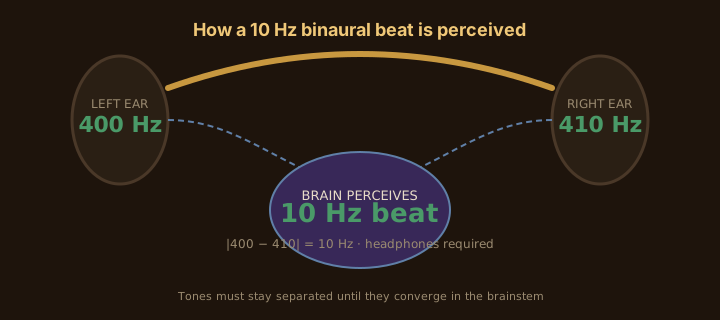
Binaural Beat Machine generates a true-stereo binaural pair. Left oscillator, right oscillator, a designed difference, stereo to the ears. That is the instrument. The build is on methodology. The live board is the Console. How the pair is made, in engineer language, is how binaural beats are generated.
If you wanted pulses on a speaker, that is a different machine. I am not insulting that machine. I am refusing to pretend it is this one. Know which tool you bought. Then the sit can match the path.
How to listen without fooling yourself
Name the signal before you press play. If the copy says binaural, put stereo headphones on and pan-test. If the copy says isochronic, you may use a speaker, and you should hear a pulse in the amplitude. If the copy says monaural, you are listening to a mix; one ear can be enough. If the copy says all three as synonyms, you are in a catalog, not a lab.
- Binaural: cups, both ears, no mono. See the headphones guide.
- Isochronic: pulse in one stream; headphones optional.
- Monaural: physical beat; headphones optional.
The definition demo is what are binaural beats. The A/B room for binaural versus already-mixed is binaural vs monaural beats. Operator procedure for the binaural object is how to use binaural beats. Band names, once you know which pipes you are holding, are brainwave bands and the calculator.
Do not transfer claims across types. A modest binaural anxiety signal in a preoperative wait is not a license to market isochronic kitchen-speaker files as the same study. Keep the pipes labeled. Mixed evidence is already hard enough without mixing the stimuli.
I have no trophy to hand you. Binaural is the instrument I built because I wanted the dichotic pair under honest copy. Isochronic and monaural will keep existing whether I like their YouTube or not. Your job is to know which one is in the file. Then ENGAGE, or don’t. The hour does not require a brand.
Why catalogs glue the words
Searchers type “beats.” Uploaders want one keyword. A pulsed AM file, a pre-mixed wobble, and a dichotic pair all get the same thumbnail font. The mystic layer does not care about the plumbing. Your setup has to. If you came from a speaker-friendly track and then “tested” this console without headphones, you did not falsify Oster. You changed the experiment and kept the name.
Acoustic beating — two close tones in the same air — is the older cousin. You can record it with one microphone. Binaural will not show up on that microphone as a third tone. That is the whole joke of the 1973 piece, and it is still the joke in 2026. Air path versus ear path. This desk does ear path. The comparison pages exist so you can hear the difference instead of arguing with a caption.
A fair A/B
Same nominal rate, say 8 Hz. First: binaural, cups on, 200 and 208, true stereo. Second: a monaural mix of those two tones into both ears. Third, if you have one: an isochronic pulse at 8 Hz on a speaker. Write three words after each. Texture, effort, whether you needed isolation. That afternoon will teach you more than a ranking article. I still will not tell you which one you must keep. I will tell you which one this console is.
When you read a paper, read the methods for the stimulus. Dichotic carriers? Mixed tones? Clicks? AM envelope? Duration? Control track? If those sentences are missing, the abstract is a mood, not a result. Garcia-Argibay pooled binaural work. Padmanabhan used binaural-beat audio in a wait. López-Caballero tested binaural parameters and reported a null. None of those sentences is a license to market a kitchen-speaker pulse as the same object.
Open the Console if you want the dichotic pair. Put the cups on. If you wanted a speaker pulse, you already know you are in the wrong room — and that is a useful thing to know before you waste an evening. Isochronic does not require headphones. Monaural is a physical mix. Binaural does require isolation. Those three sentences are the whole comparison. I will repeat them as often as catalogs glue the names back together. Know the pipes. Then the sit can match the path, or the speaker can match the pulse, and you stop arguing with a thumbnail.
What we still do not know
We do not have a clean, large, head-to-head literature that puts binaural, isochronic, and monaural through identical tasks, carriers, and blinding and then tells you which texture “wins.” We have separate pipes, overlapping marketing words, and a habit of citing the nearest abstract. Until someone runs that comparison with adult methods, the honest move is to name the stimulus you actually played — and to stop pretending a speaker-tolerant pulse is the Oster object.
Questions operators actually ask
Do isochronic tones need headphones?
No. Isochronic is a pulsed amplitude in one stream. A speaker can carry it. Binaural beats do need stereo headphones. If a file works on speakers, it was not asking for a binaural test.
What is a monaural beat?
A physical mix of two close tones. The loudness wobble exists in the waveform or in the air before it reaches you. One ear can be enough. It is closer to tuning-fork physics than to a brainstem comparison.
Which is best: binaural, isochronic, or monaural?
None as a trophy. They are different signals. Choose binaural when you have stereo cups and want the dichotic pair. Choose isochronic or monaural when you need a speaker-tolerant pulse. Match the tool to the constraint.
Can I use the same research for all three?
No. A binaural meta-analysis is not an isochronic paper. A monaural anxiety study is not a binaural anxiety study. Keep the pipes labeled.
What does Binaural Beat Machine generate?
A true-stereo binaural pair: two oscillators, hard-panned, a designed difference. Headphones required. It is not an isochronic pulser and not a pre-mixed monaural beat.
Why did my binaural file work on speakers?
Then you were not hearing a binaural beat. You may have been hearing leakage, an acoustic smear, or extra layers in the production. The dichotic object needs isolation.
Where can I hear binaural versus already-mixed?
The learn page for binaural versus monaural is built as an A/B. Headphones on. Same numbers, different delivery. That is the experiment catalogs skip.
Keep reading
Educational listening notes from a working audio engineer. Not medical advice. Not a medical device. Headphones required for a true binaural beat. Methodology · About · Garcia-Argibay 2019